If you are comparing urinary tract supplements, you are probably looking for something more useful than a familiar ingredient name on the front of a bottle. You want to understand what the formula is built around, how it fits a daily routine and whether the product actually matches the reason you started searching.
That distinction is important because cranberry, D-mannose, Aloe-based formulas and men’s prostate products can all appear close together in a wellness range while answering very different needs. A clearer choice begins by separating those routes before choosing the product.
Start with the role: are you looking for a simple urinary-wellness formula, trying to compare cranberry with D-mannose, or actually dealing with a different need such as prostate support or general drainage? Once the role is clear, the label becomes much easier to interpret.
Urinary-tract and prostate-focused searches should not be treated as the same category. For a male prostate-specific comparison, see Prostate Supplements: Ingredients, Formula Differences & What to Check; for the Etna-specific route, see the ProstaMan Etna Wellness guide.
Why the ingredient name alone does not tell you enough
Cranberry is familiar. D-mannose is increasingly familiar. That familiarity can make the buying decision feel almost automatic: if both appear together, the formula must be “complete”.
But a more useful comparison asks what each ingredient contributes to the formula, whether the amounts are clearly declared, how often the product is taken and what evidence exists for the type of outcome you have in mind.
This reframes the choice from “which urinary supplement sounds strongest?” to “which formula is transparent enough for me to understand why I am choosing it?”
Cranberry and D-mannose are not interchangeable
Cranberry is a fruit-derived ingredient used in many urinary-wellness products. D-mannose is a simple sugar used in a different way within supplement formulas. Putting both in the same category does not make them the same ingredient or give them identical evidence.
This matters because the formula can look simple while the decision behind it is more nuanced. A product containing both ingredients may be convenient, but convenience should not replace understanding.
| What you are comparing | Why it matters | Useful label check |
|---|---|---|
| Cranberry | Evidence varies by population and product preparation. | Exact cranberry preparation, amount and any declared standardisation. |
| D-mannose | It has its own evidence base and should not borrow claims from cranberry. | Exact daily amount and serving instructions. |
| Combination formula | Combining ingredients can improve convenience, but not automatically efficacy. | Whether both ingredients are quantified clearly enough to make a meaningful comparison. |
What the current evidence means for a conscious choice
Cranberry has a more developed evidence base than many people realise, but the useful conclusion is not “cranberry always prevents UTIs”. A large Cochrane review found evidence of reduced recurrent symptomatic, culture-verified UTIs in some groups, including women with recurrent UTIs, while results were not the same across every population or preparation.
D-mannose should be considered separately. A large UK randomised placebo-controlled trial in women with recurrent UTIs found that daily D-mannose did not reduce the proportion experiencing another medically attended UTI over six months.
This difference is valuable because it prevents the common mistake of treating two popular ingredients as if they had the same strength or type of evidence. A thoughtful purchase does not require dismissing either ingredient; it requires understanding what the evidence can and cannot tell you.
Where CistinStop fits
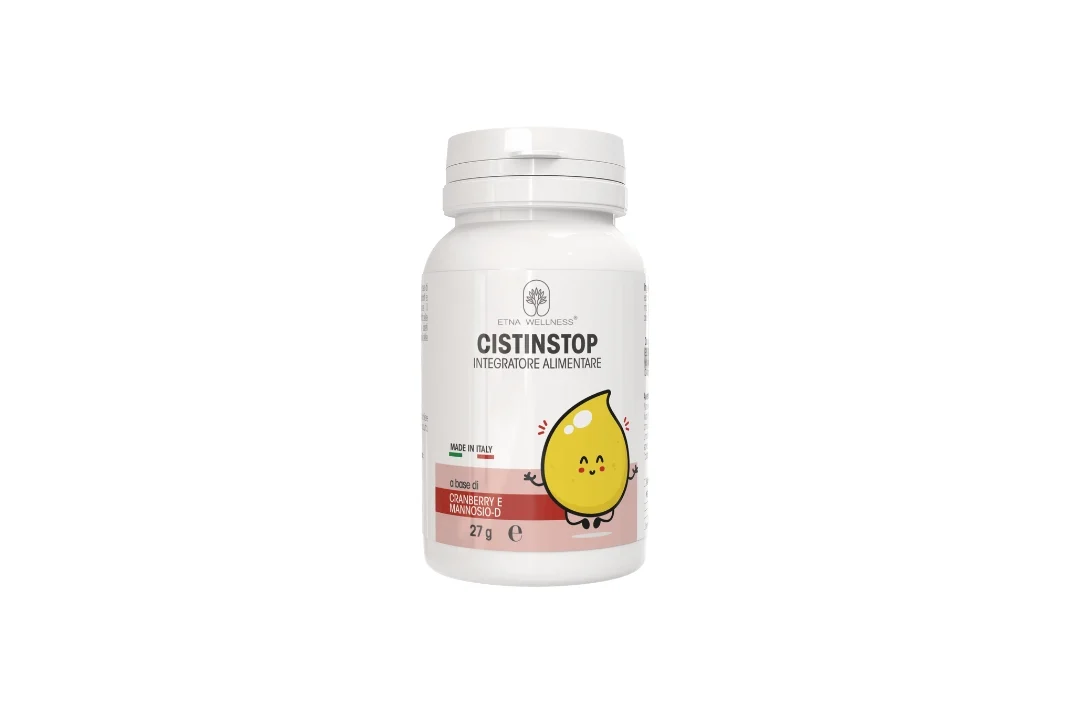
The current English Etna Wellness catalogue identifies CistinStop as a formula containing cranberry and D-mannose. The current catalogue direction is 1 capsule per day with water.
That gives the product a clear role inside the range: it is the most direct urinary-wellness bridge when you specifically want a cranberry + D-mannose combination in a simple capsule routine.
The current source set does not yet give a direct current English technical sheet with the exact cranberry and D-mannose quantities. Those milligram amounts therefore remain intentionally unpublished here rather than being reconstructed from older or secondary material.
This is actually useful for the buying decision. It keeps the value proposition honest: you can understand the formula identity and daily routine now, while the exact quantitative comparison remains something to verify on the current label before purchase.
Why one capsule a day can increase practical value
A simple routine has value when simplicity is part of what you are looking for. One capsule per day is easy to understand and easy to remember compared with a product that requires several servings at different times.
That does not make CistinStop “better” than every other urinary formula. It simply gives it a practical advantage for someone whose priority is a straightforward cranberry + D-mannose route.
Imagine the routine three weeks after purchase rather than on the first day. If you can see yourself taking the product consistently without reorganising your day around it, the formula may already have more practical value for you than a more complicated option.
Keep Aloe Nettle in its own adjacent role
Aloe Nettle sits close to urinary and drainage themes because its formula combines Aloe with nettle, but it should not be presented as a substitute for the direct cranberry + D-mannose route.
The current Aloe Nettle sheet describes 90% Aloe Vera gel, 6.5% honey and 2% nettle extract, with a daily amount of 100 ml divided into two or three servings.
That creates a different decision. CistinStop is a simple capsule formula centred on cranberry + D-mannose; Aloe Nettle is a drinkable Aloe-plus-botanical formula. If the need is specifically urinary-formula comparison, CistinStop remains the clearer direct route. If the desired routine is broader and Aloe-led, Aloe Nettle belongs in that separate comparison.
Keep prostate support separate too
Urinary searches can sometimes overlap with men’s prostate concerns, but they should not be merged into one buying path. A man looking at urinary changes may have a very different decision from someone simply comparing a cranberry-based supplement.
For that reason, ProstaMan and the dedicated Prostate Supplements guide remain a separate route rather than being folded into this article.
This separation increases clarity: each product is easier to evaluate when it is connected to the need it was actually designed to address.
How ethical upselling should work in the urinary category
The wrong approach would be to turn every urinary-wellness search into a bundle of CistinStop + Aloe Nettle + drainage products + prostate support.
The better approach is much simpler: identify the dominant need, choose the most coherent route and add a second formula only if there is a second distinct reason that can be explained clearly.
That makes the decision more persuasive because the customer sees why an extra product might add value — and equally why it may not be necessary.
Upselling becomes a question of relevance, not quantity.
What to check when comparing two urinary supplements
- Formula identity: cranberry, D-mannose, both, or another route entirely?
- Exact quantities: are the main ingredients clearly quantified?
- Preparation: what form of cranberry is used and is any standardisation declared?
- Daily routine: how many capsules, scoops or servings are required?
- Evidence: are you looking at ingredient-level evidence or a claim about the finished product?
- Fit: can you realistically see yourself following the routine consistently?
When these points are clear, the label stops feeling like a collection of reassuring words and starts becoming a decision tool.
Picture the choice after the marketing disappears
Imagine the front label without words such as “urinary”, “bladder” or “support”. Would you still understand what the product contains, how you take it and why you selected it?
If the answer is yes, your decision is becoming more conscious. You are choosing the formula rather than the promise.
For CistinStop, the current decision is straightforward: cranberry + D-mannose, one capsule per day, with the exact quantitative details to be checked on the current label when you access the product.
Choose the urinary route first, then verify the current formula
If you are still deciding whether your need is urinary wellness, Aloe/botanical support, prostate support or general drainage, start from the wider needs guide. If the cranberry + D-mannose route is already clear, ask for current product information or create customer access and verify CistinStop’s present label, price and availability before deciding whether to order.
Ask about the current CistinStop formula
Create customer access & check CistinStop
Creating customer access does not place an order. On mobile, scroll down on the registration page, complete your customer details, enter the shop and verify the current product, formula, format, price and availability before ordering.
Frequently asked questions
Does CistinStop contain cranberry and D-mannose?
Yes. The current English Etna Wellness catalogue identifies both ingredients in the formula.
How is CistinStop currently taken?
The current English catalogue states one capsule per day with water.
Why are the exact cranberry and D-mannose amounts not shown here?
Because the current project source set does not yet include a direct current English technical sheet that confirms those quantitative values. They should be checked on the current label rather than inferred.
Is cranberry the same as D-mannose?
No. They are different ingredients with different evidence bases and should be evaluated separately even when combined in one formula.
Can a cranberry or D-mannose supplement treat an active UTI?
A supplement should not be treated as a substitute for appropriate assessment or treatment of an active urinary infection. The formula comparison in this guide is intended for an informed wellness-product decision.
Bottom line
The strongest urinary-supplement decision is not the formula with the most familiar ingredient names. It is the one whose role, evidence, daily routine and label transparency you understand. CistinStop currently offers a simple cranberry + D-mannose capsule route, while adjacent Aloe, drainage and prostate products remain separate choices for separate needs.
A few useful notes before you choose
Urinary discomfort is common, and many people first notice changes such as needing to urinate more often, urgency or discomfort. When you are simply comparing a wellness product, the ingredient framework above is a useful way to make the choice feel clearer.
If symptoms suggest an active UTI, NHS guidance provides a straightforward route to appropriate care. In England, many women aged 16–64 who are not pregnant or breastfeeding can start with a pharmacist. Some situations — including pregnancy, male urinary symptoms, blood in the urine, fever or shivering, back pain, recurrent infections or symptoms that worsen or do not improve — merit more direct medical advice. This is a useful context check rather than a reason to feel alarmed.
Cranberry evidence also depends on who is using it and for what purpose. Cochrane’s 2023 review found benefit for prevention in some recurrent-UTI populations, but not uniformly across every group, while a separate Cochrane review found no good-quality evidence that cranberry treats an existing UTI. D-mannose also has a separate evidence base: a large 2024 UK primary-care trial did not find a preventive benefit in women with recurrent UTIs.
As a simple final check, follow the current label for the exact product you choose. If pregnancy, regular medicines, recurring urinary problems or an existing health condition are relevant to you, checking suitability with an appropriate healthcare professional can add confidence to the decision.
Sources and verification
- Cochrane — Cranberries for preventing urinary tract infections: evidence context for recurrent UTI prevention in specific populations.
- Cochrane — Cranberries for treating urinary tract infections: no good-quality evidence supporting cranberry as treatment for an existing UTI.
- JAMA Internal Medicine — d-Mannose for prevention of recurrent UTI: 2024 UK primary-care randomised trial.
- NHS — Urinary tract infections (UTIs): symptom, treatment and medical-assessment context.
Product-specific facts in this draft are anchored to the current English Etna Wellness catalogue and project source reconciliation: CistinStop = cranberry + D-mannose, one capsule per day with water. Exact ingredient quantities remain gated until a direct current English technical sheet or label is available. Aloe Nettle formula details use the current product sheet already supplied for this project. External evidence context was refreshed on 21 September 2026 against NHS UTI guidance, the 2023 Cochrane cranberry reviews and the 2024 UK randomised D-mannose trial. No finished-product claim to prevent or treat UTI is adopted.