Searching for the “best collagen supplements UK” can quickly turn into a list of brands, star ratings and headline doses. That is not the most reliable way to choose.
A better approach is to decide what you want the supplement to do, which collagen format matches that goal, how much of the relevant ingredient you actually get per daily serving, and whether the claims are stronger than the evidence.
Quick answer: there is no single “best collagen supplement” for everyone. In the UK, compare the exact collagen source, form, daily amount, co-ingredients, allergens, evidence, label transparency and practical routine fit. Then shortlist products that match your actual goal.
Why UK “top 10 collagen supplements” lists can mislead
Collagen products can differ in source, type, degree of hydrolysis, daily amount, additional nutrients, flavouring, format and intended use. A powder aimed at a skin-oriented routine is not automatically comparable with an undenatured type II collagen product or a broader mobility formula.
So the useful question is not “which brand is number one?” but which formula is the best fit for this specific need?
Step 1: define the outcome before comparing products
Start with the reason you are looking for collagen:
- skin-oriented support;
- mobility or joint-focused formula comparison;
- general collagen intake;
- a vegan-compatible route;
- a simple single-ingredient powder;
- a broader formula with vitamin C, hyaluronic acid, glucosamine or other co-ingredients.
These are different buying decisions. Trying to make one product win every category usually creates a weak comparison.
Step 2: check the collagen source
Common supplement sources include bovine and marine collagen. Some joint-focused products use cartilage-derived type II collagen preparations. Vegan-labelled products may not contain conventional collagen at all and can instead be collagen-support formulas or, more rarely, recombinant collagen products.
Source matters for dietary preference, allergens and the type of evidence that is relevant.
For the broader source comparison, see Collagen Supplements: Types, Sources, Evidence & How to Choose.
Step 3: check the collagen form
Terms such as hydrolysed collagen, collagen peptides, native collagen and undenatured type II collagen are not interchangeable.
Hydrolysed collagen is broken into smaller peptides and is commonly supplied in gram-level servings. Undenatured type II collagen is a different preparation with different dose conventions and evidence.
If type II collagen is specifically what you are researching, use the dedicated Type II Collagen Supplements guide.
Step 4: compare the actual daily collagen amount
The tub size does not tell you how much collagen you consume each day. Neither does the number of scoops unless the label quantifies the collagen within those scoops.
Look for:
- serving size;
- recommended daily servings;
- grams or milligrams of collagen per daily amount;
- whether the figure refers to collagen itself or the total powder weight.
This is one of the quickest ways to separate a transparent formula from a vague one.
Step 5: decide whether co-ingredients add real value for your goal
Some collagen products add vitamin C, hyaluronic acid, biotin, zinc, glucosamine, minerals or botanical ingredients.
More ingredients do not automatically make a formula better. Each added ingredient should answer a real need and should be present at a clearly stated amount.
For example, vitamin C can legitimately be relevant because it contributes to normal collagen formation for the normal function of several tissues when the authorised conditions of use are met. That is different from claiming that a finished supplement reverses ageing or repairs joints.
Step 6: separate beauty formulas from mobility formulas
One of the biggest comparison errors is treating every collagen product as if it serves the same goal.
A beauty-oriented formula may combine hydrolysed collagen with vitamin C or hyaluronic acid. A mobility-oriented formula may combine collagen with glucosamine or other ingredients. Neither architecture is automatically “better”; they answer different questions.
Use Collagen for Skin vs Joints when the goal itself is still unclear.
Step 7: check the evidence, not only the marketing
Current systematic reviews and umbrella reviews show encouraging findings for some oral collagen preparations across skin and musculoskeletal outcomes, but study quality, formulation, dose and duration vary.
Evidence for one hydrolysed collagen preparation cannot automatically prove that every commercial collagen supplement produces the same result.
For the evidence-specific owner, see Do Collagen Supplements Work? What the Evidence Actually Shows.
Step 8: check whether the claim is legal and proportionate in the UK
In Great Britain, food supplements are foods rather than medicines. Product labels and advertising must therefore stay within applicable food-supplement and nutrition/health-claim rules.
UK guidance also makes an important distinction: foods and supplements cannot be advertised as treating, preventing or curing disease. Collagen advertising is especially sensitive because claims about hydration, joints or physiological skin effects can cross into regulated health or medicinal territory.
A responsible buyer should therefore treat aggressive physiological or disease-style claims as a reason to investigate the evidence more carefully, not as a reason to trust the product more.
Step 9: compare allergens and dietary fit
Marine collagen can matter for fish allergy. Some joint-oriented formulas may use shellfish-derived glucosamine. Bovine collagen will not suit vegan diets, and a “vegan collagen” product may be a completely different formula category.
Always check the current label rather than assuming source or suitability from the product name.
Step 10: compare format and routine fit
A technically strong formula is not useful if you will not take it consistently.
Compare:
- powder vs capsule vs liquid;
- serving frequency;
- flavour or unflavoured format;
- mixability;
- daily volume;
- how easily it fits breakfast, a drink or another existing routine.
Step 11: compare price only after normalising the serving
Price per tub is a poor comparison when products use different serving sizes and different amounts of collagen.
A more useful comparison is:
- cost per daily serving;
- cost per gram of collagen where the collagen amount is clearly stated;
- cost of relevant co-ingredients;
- whether you are paying for flavour, format or added ingredients you actually value.
Current prices and promotions change, so verify them in the live shop rather than relying on an editorial article.
How to compare the best collagen supplements in the UK: a practical scorecard
| Criterion | Strong signal | Question to investigate |
|---|---|---|
| Source | Clearly stated bovine, marine, type II or other source. | Is the source vague? |
| Form | Hydrolysed/native/undenatured form is explicit. | Is “collagen” the only description? |
| Daily amount | Collagen amount per daily serving is quantified. | Does the label show only scoop or tub weight? |
| Co-ingredients | Amounts and roles are clear. | Are they included mainly for marketing? |
| Evidence | Claims match the exact preparation or authorised nutrient wording. | Is evidence borrowed from another collagen form? |
| Suitability | Allergens and dietary source are easy to identify. | Could fish, shellfish or animal source matter? |
| Routine | Serving is realistic for daily use. | Will the format become inconvenient? |
How Etna Wellness collagen formulas fit this framework
Etna Wellness collagen products should be evaluated with the same criteria rather than being declared “best” because they are sold on this site.
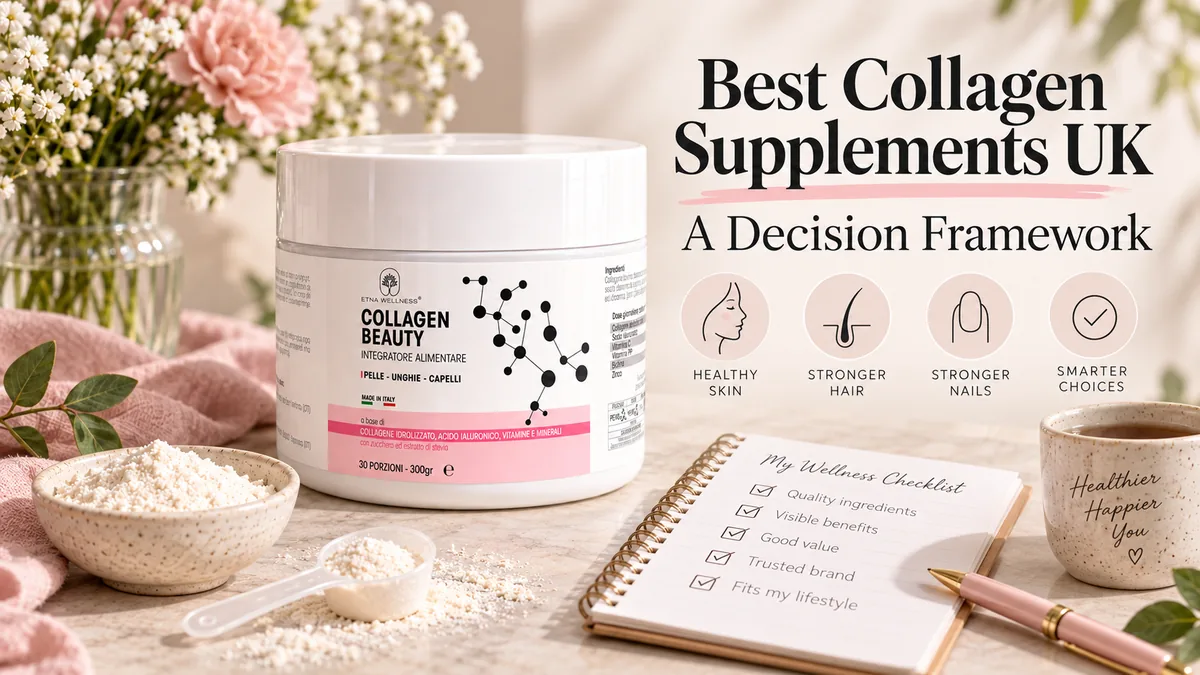
Collagen Beauty is the clearest current beauty-oriented example in the project source set. Its supplied technical sheet describes a 10 g daily serving containing 7.5 g hydrolysed collagen, 100 mg sodium hyaluronate and 80 mg vitamin C.
This allows a transparent formula comparison: collagen amount, hyaluronate and vitamin C are quantified. It does not justify a guaranteed wrinkle, anti-ageing or skin-treatment promise.
Collagen Extra Beauty belongs to the same beauty branch but uses a different formula architecture and serving structure. Compare the exact current label rather than assuming it is simply a stronger version of Collagen Beauty.
Collagen Extra Freedom belongs to the mobility-oriented branch, but the current English documentation is not sufficient for a fully quantified UK comparison. It therefore remains a qualitative mobility example until the exact current formula can be verified from current product information.
Which collagen formula is best for skin?
Do not choose from a “skin” label alone. Compare the collagen source and dose, added nutrients, evidence, allergens and routine fit.
If your goal is specifically skin-oriented, Collagen Beauty can be compared transparently because the current supplied formula is quantified. That still does not make it universally superior to every other collagen product on the UK market.
Which collagen formula is best for joints?
First decide whether you are comparing hydrolysed collagen, undenatured type II collagen, glucosamine-containing formulas or a broader mobility route. These are different formula families.
For type II specifically, use the Type II Collagen Supplements guide. For the wider mobility decision, use Joint & Mobility Supplements: Formula Types & What to Compare.
What if you need vegan collagen?
Conventional bovine and marine collagen are not vegan. Many “vegan collagen” products are actually collagen-support formulas rather than collagen protein.
See Collagen Supplements: Types, Sources, Evidence & How to Choose before assuming two products belong in the same comparison.
Picture the choice without the brand name
Imagine every label has the brand removed. You can see only the source, form, collagen amount, co-ingredients, allergens, directions and evidence.
Would you still choose the same product? If yes, the decision is probably being driven by formula fit rather than branding.
Build your shortlist by criteria, not rankings
If you are still deciding what kind of collagen formula fits your goal, start with the needs guide. If you want help comparing current labels, ask for information. If you are ready to inspect Etna Wellness products available to your market, create customer access and verify the live label, format, price and availability before ordering.
Ask for help comparing collagen formulas
Create customer access & check current products
Creating customer access does not place an order. On mobile, scroll down, complete your customer details, enter the official shop, then verify the current product, format, price and availability before ordering.
Frequently asked questions
What is the best collagen supplement in the UK?
There is no single product that is objectively best for everyone. The useful choice depends on your goal, collagen source and form, daily amount, co-ingredients, allergens, evidence and routine fit.
Is marine collagen better than bovine collagen?
Not universally. Source changes the formula and suitability, but evidence should be matched to the exact preparation rather than treating source alone as a quality ranking.
How much collagen should a supplement contain?
There is no one dose that applies to every collagen form and outcome. Compare the daily amount with the preparation and evidence relevant to your goal.
Are collagen drinks better than powders?
Format alone does not make a product better. Compare the actual collagen amount, formulation, evidence, convenience and cost per daily serving.
What should I avoid in a collagen supplement?
Be cautious with unclear source, undisclosed collagen amount, exaggerated disease or guaranteed-result claims, hidden allergens and comparisons that rely only on tub size or marketing language.
Can I compare Collagen Beauty with Collagen Extra Freedom directly?
Only after defining the goal. Collagen Beauty is a beauty-oriented formula; Collagen Extra Freedom belongs to the mobility branch. They should not be treated as interchangeable products.
A few useful notes before you choose
In Great Britain, food supplements must follow food-supplement labelling and claims rules. They should not be presented as products that diagnose, treat, prevent or cure disease. Always use the current label as the final reference for ingredients, allergens, directions and warnings.
If you are pregnant or breastfeeding, take medicines, have a medical condition or are considering collagen for persistent joint or skin symptoms, seek appropriate professional advice.
Sources and verification
- UK Food Standards Agency — Food supplements guidance.
- GOV.UK — Nutrition, health claims and supplement labelling.
- ASA/CAP — Food supplements and skincare claims.
- 2026 umbrella review — collagen supplementation for skin and musculoskeletal health.
- Current Etna Wellness collagen technical materials — used only for formula-specific facts.
Independent distributor notice: this website is operated by an independent Etna Wellness distributor and is not the official corporate website. This guide provides decision criteria rather than a ranked recommendation, and current product details should be verified from the live label and official shop.