When you are choosing a collagen supplement for skin, the most useful question is not which tub has the most dramatic beauty language. It is whether the formula, daily amount and routine actually match what you want to compare. Skin-focused collagen products can look similar on the front of the pack while differing in collagen form, quantity, vitamin C, hyaluronate, added micronutrients, flavour, serving size and evidence behind the claims.
This guide is the skin-specific decision owner. If your real question is whether your priority is skin or joints, use the skin vs joints collagen guide. If you want the detailed product sheet for one Etna Wellness formula, see Collagen Beauty Etna Wellness: Ingredients, Dose & Evidence. For the broader collagen category, start with Collagen Supplements: Types, Sources, Evidence & How to Choose.
Start with the goal, then read the formula
“Collagen for skin” is a useful shopping phrase, but it is not a scientific category that guarantees a particular result. A more reliable comparison starts with measurable features: the collagen source and form, the amount supplied by the recommended daily serving, the presence and amount of supporting nutrients, the preparation method, allergens, and how realistic the routine is for you.
A formula that fits your day can be more valuable than a formula with a longer ingredient list that you do not understand or will not use consistently.
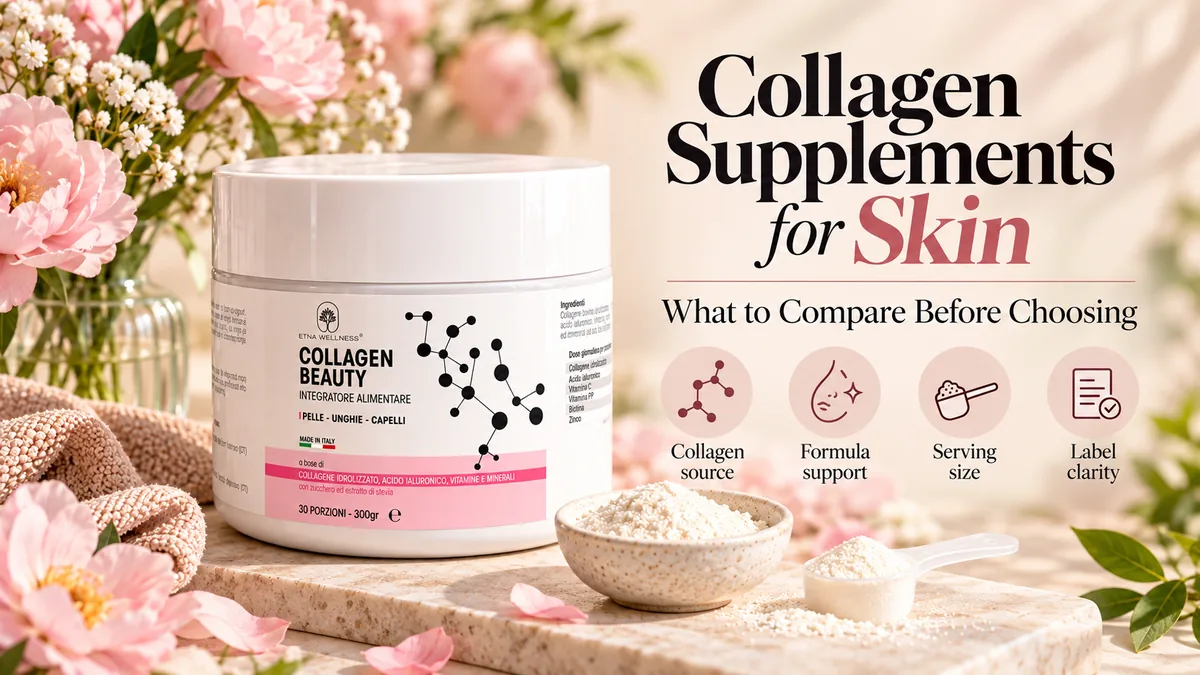
How to choose the best collagen for skin: five things to compare
| What to check | Why it matters | What not to assume |
|---|---|---|
| Collagen form and source | Tells you what the collagen ingredient actually is and can affect suitability. | That one source is automatically superior for every person. |
| Daily collagen amount | Lets you compare the real serving rather than front-label impressions. | That the largest gram number guarantees a better cosmetic outcome. |
| Vitamin C and other co-nutrients | Shows whether the formula is collagen-only or a broader beauty-style blend. | That every added ingredient has proven finished-product effects. |
| Format and preparation | Powder, liquid, capsule and serving volume change the practical routine. | That the most convenient format contains the same amount as a powder. |
| Evidence and claim quality | Separates ingredient research from promises about a specific finished product. | That evidence on one collagen preparation proves another product will do the same. |
What does “hydrolysed collagen” tell you?
Hydrolysed collagen has been broken down into smaller peptides. That is common in oral collagen powders and is useful product information, but it does not by itself tell you that a formula is “best for skin”. The daily quantity, the rest of the formula and the evidence behind the exact claim still matter.
What does the research on oral collagen and skin actually show?
Research is encouraging in some areas but should be read with restraint. A 2026 systematic review of randomised controlled trials reported improvements in several skin outcomes across many trials, while also noting that most included studies had a high risk of bias and that better standardised, longer-term trials are needed. A 2025 meta-analysis found overall improvements in hydration, elasticity and wrinkles, but those effects disappeared in analyses restricted to higher-quality or non-industry-funded studies.
That means the evidence is not a licence to promise wrinkle reduction or younger-looking skin from a specific product. It is better used to understand why oral collagen is studied, while keeping the finished-product decision tied to its actual formula.
Vitamin C: a clearer authorised role
Vitamin C has a more clearly defined regulatory role than broad cosmetic promises. Under EU authorised health-claim rules, vitamin C contributes to normal collagen formation for the normal function of skin when the conditions of use are met. This is a nutrient claim; it does not mean a collagen supplement is proven to reverse ageing or remove wrinkles.
Where Collagen Beauty Etna Wellness fits
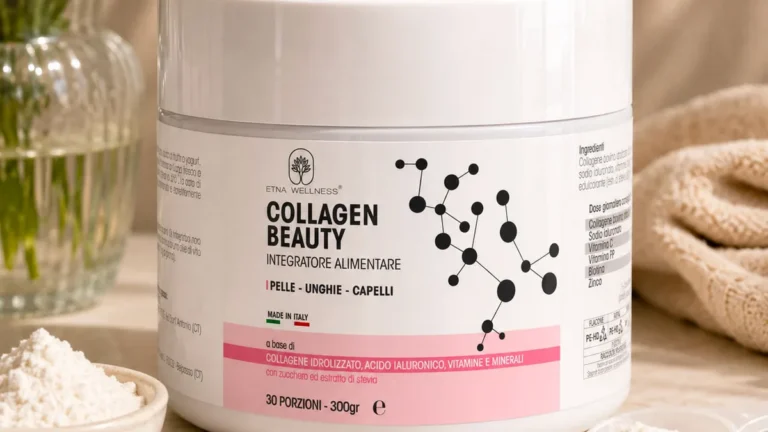
The current Etna Wellness technical sheet describes Collagen Beauty as a 300 g powdered food supplement providing 30 daily servings. The recommended serving is 10 g, prepared in about 150 ml of cold water, fruit juice or yoghurt, preferably in the morning.
Per 10 g daily serving, the current sheet declares 7.5 g hydrolysed collagen, 100 mg sodium hyaluronate and 80 mg vitamin C. It also lists niacinamide, biotin and zinc oxide among the ingredients. These are formula facts, not guarantees of a cosmetic result.
For someone comparing skin-focused formulas, the practical value is that the core quantities are relatively easy to see and compare: the collagen amount is declared, sodium hyaluronate is quantified, and vitamin C is quantified. If you need the full product-level breakdown, use the dedicated Collagen Beauty guide.
How Collagen Extra Beauty differs
Collagen Extra Beauty follows a different formula architecture. The current supplied label shows a 210 g pack with 42 portions of 5 g, with directions for 1 or 2 scoops and a maximum of 10 g per day. It contains hydrolysed bovine collagen, vitamin C, biotin, zinc oxide and a fruit-and-vegetable mix.
At the stated maximum daily serving of 10 g, the supplied label declares 20 mg fruit-and-vegetable mix, 80 mg vitamin C and 50 µg biotin. The current source does not provide a sufficiently locked collagen-gram value for this formula, so this guide does not invent one.
The useful comparison is therefore not “Beauty vs Extra Beauty, which is stronger?” but whether you prefer the more directly quantified Collagen Beauty profile or the broader Extra Beauty formula and serving structure.
Do not judge a skin collagen only by the number of ingredients
A long ingredient list can increase perceived value, but extra ingredients only matter when they are relevant to your goal, present in meaningful quantities and supported by appropriate evidence. More ingredients do not automatically make a product more effective, and a simpler formula is not automatically weaker.
Powder, capsules or liquid: routine fit matters
Before choosing, imagine the routine rather than the marketing. Will you measure a powder each morning? Would you prefer a pre-portioned format? Do you want to mix it with water, juice or yoghurt? Does the flavour matter? Will you remember it consistently? These questions sound basic, but they often decide whether a product becomes a real routine or remains unused.
A simple decision sequence
- Confirm that skin is your real priority. If mobility is equally important, use the skin-vs-joints comparison first.
- Check the collagen form and source.
- Compare the declared daily amount.
- Check vitamin C, hyaluronate and other co-nutrients individually.
- Read the exact serving and preparation directions.
- Check allergens and current warnings on the physical label.
- Separate research on collagen generally from evidence for the exact finished product.
- Choose the formula you can realistically use and understand.
Think one month ahead: the right formula is not the one that looks most impressive today. It is the one whose composition makes sense to you and whose daily routine still feels realistic after the novelty has worn off.
Compare the current Etna Wellness skin-collagen routes
If you want help deciding which formula fits your needs, use the Find the right products for your needs route or request information.
When you are ready to check the live shop, you can create customer access and verify the current label, price and availability for your country. Creating customer access does not place an order.
Frequently asked questions
Is more collagen always better for skin?
No. The daily amount is useful for comparison, but a larger number does not guarantee a better cosmetic result. Formula quality, evidence, suitability and routine fit all matter.
Does hydrolysed collagen mean it is specifically for skin?
No. Hydrolysed describes the collagen form. It does not by itself establish a skin-specific effect.
What is the clearest skin-related nutrient claim in these formulas?
Vitamin C has an authorised role in normal collagen formation for the normal function of skin, subject to the applicable conditions of use.
How much collagen does Collagen Beauty provide?
The current technical sheet declares 7.5 g of hydrolysed collagen per 10 g daily serving.
Is Collagen Extra Beauty simply a stronger version of Collagen Beauty?
No. They are different formula designs. Extra Beauty has a different serving structure and broader ingredient profile; the current source set does not support reducing the choice to a simple “stronger” or “weaker” ranking.
Do collagen supplements guarantee fewer wrinkles?
No. Reviews of oral collagen research reach mixed conclusions, and evidence for collagen preparations generally does not guarantee a result from a specific finished product.
A few useful notes before you choose
Use the current physical label as the final reference for collagen source, allergens, serving size, warnings and suitability. If you are pregnant or breastfeeding, take medicines, have a medical condition, have significant food allergies, or need to avoid a particular animal source, seek appropriate professional advice before use.
Food supplements should not replace a varied, balanced diet and a healthy lifestyle.
Sources and verification
- Current Collagen Beauty technical sheet supplied for ETNA.COM editorial review — primary source for product identity, serving size and declared formula quantities.
- Current Collagen Extra Beauty label supplied for ETNA.COM editorial review — primary source for serving structure and declared formula details.
- 2026 systematic review of randomised controlled trials of hydrolysed collagen and skin outcomes.
- 2025 systematic review and meta-analysis examining study quality and funding source.
- Commission Regulation (EU) No 432/2012 — authorised EU nutrition and health claims, including vitamin C and normal collagen formation for normal skin function.
Independent distributor notice: this website is operated by an independent Etna Wellness distributor and is not the official corporate website. Product information is provided for general informational purposes and does not replace the current product label or professional medical advice.