If you search for protein supplements for weight gain, the results often mix ordinary protein powders with mass gainers, meal shakes and high-energy products. Those are not the same thing.
A protein powder can add protein without providing a large amount of energy. A mass gainer usually increases total energy much more deliberately. Understanding that difference is more useful than assuming “more protein” automatically means “more weight gain”.
Protein powder and mass gainer are different product roles; compare total energy, protein and serving size before choosing. — www.etnawellnesselitegroup.com
Weight gain requires more than a protein label
Body weight changes when overall energy intake and expenditure change over time. Protein can be part of a balanced eating pattern, but an ordinary protein supplement is not automatically designed to create the higher energy intake associated with weight gain.
The NHS recommends a gradual approach to healthy weight gain, using a balanced diet and additional energy rather than relying on sugary foods or drinks. Unintentional or sudden weight loss should be medically assessed.
Protein powder and mass gainer: the core difference
Feature
Protein-focused powder
Mass-gainer style product
Main emphasis
Protein provision
Higher total energy plus protein
Carbohydrate
Can be modest
Often much higher
Serving size
Often smaller
Often substantially larger
Best comparison
Protein grams, source, ingredients
Total energy, protein, carbohydrate, serving practicality
Check total energy per prepared serving
Do not judge from dry-powder weight alone. Compare the complete serving, including the recommended amount of powder and the preparation liquid. A product mixed with water may have a very different energy total from the same powder mixed with milk.
Check protein, carbohydrate and serving size together
For weight-gain intent, protein is only one part of the picture. A much larger serving with more carbohydrate may supply considerably more energy than a concentrated protein powder. That does not make it universally better; it makes it a different format.
When an ordinary protein supplement may not match the search intent
A mass-gainer comparison should use the prepared serving, not just the powder in isolation. The amount of powder, the recommended liquid and any additional ingredients can change total energy substantially. A large serving mixed with milk can sit in a very different nutritional range from a smaller protein serving mixed with water.
For that reason, compare kilocalories, protein, carbohydrate, fat and serving size on the same prepared basis. This also makes it easier to see whether a formula is genuinely designed as a high-energy product or is simply an ordinary protein powder used in a larger serving.
Healthy weight gain is a whole-diet question
A supplement can make food intake more convenient, but it does not replace the wider pattern. The NHS guidance on healthy weight gain emphasises gradual increases in energy intake alongside balanced meals and snacks rather than relying on high-sugar choices.
If body weight is falling without an obvious reason, or if swallowing, appetite, digestion or another health issue is making it difficult to maintain weight, that changes the decision completely. In those situations, the priority is appropriate medical or dietetic assessment rather than selecting a higher-calorie powder independently.
Where Protein Plus fits
Protein Plus Etna Wellness is presented as a protein-first supplement, not as a dedicated mass gainer. Its value should therefore be judged by its protein content, serving size and formula rather than by implying that it is designed to produce weight gain.
Safety and context matter
If you have lost weight unexpectedly, have difficulty maintaining weight, have a medical condition affecting appetite or absorption, or are considering a major dietary change, professional assessment is more appropriate than treating a supplement as the solution.
Weight-gain comparison checklist
Total energy per prepared serving
Protein grams and source
Carbohydrate and sugars
Fat and fibre
Recommended serving size
Number of servings per pack
Allergens and dietary suitability
Whether the product is genuinely a mass gainer, a protein supplement or a different type of shake
Before you choose a weight-gain product
Decide whether you actually need a protein-first supplement, a higher-energy mass-gainer format or professional support for the wider diet. That distinction makes the next product comparison much clearer.
The phrase low-calorie protein supplement sounds straightforward, but it can hide several different product types. A small serving can look low in calories simply because the portion is small, while another formula may provide more energy because it includes carbohydrate, fibre or other nutrients.
The useful question is not “Which powder has the lowest number?” It is how much protein and total nutrition do you receive for the serving you will actually use?
Compare energy and protein using the serving you will actually prepare, not a headline number in isolation. — www.etnawellnesselitegroup.com
“Low calorie” has a regulatory meaning
In EU nutrition-claim rules, “low energy” is not a casual marketing phrase. Specific energy thresholds apply, and “energy-reduced” requires a meaningful reduction compared with a similar product. That is why this guide uses “low-calorie” primarily as a search and comparison intent rather than automatically applying it as a claim to any specific Etna Wellness product.
Compare energy per serving first
Start with the prepared serving. Note the grams of powder, the liquid used for preparation and the total kilocalories. If one product uses 20 g and another 40 g, comparing only the dry-powder percentage can create the wrong impression.
Water adds no meaningful energy, while milk or other liquids change the prepared total. Keep the preparation method consistent when comparing products.
Then compare protein density
A useful protein-focused comparison looks at both protein grams per serving and the total energy of that serving. A product can be lower in energy but also lower in protein because the portion is smaller.
EU rules also define when foods may use “source of protein” or “high protein” claims. The nutrition panel is therefore more informative than an unsupported front-of-pack phrase.
Low calorie does not mean meal replacement
A protein shake does not become a meal replacement just because it is filling, fortified or relatively low in energy. Meal-replacement products belong to a different regulatory and nutritional context.
Check sugars, fat and fibre without reducing the decision to one number
Lower sugar may matter to one person; fibre may matter to another. Fat is not automatically undesirable, and a small difference in sugars can be irrelevant if serving sizes are different. Read the complete nutrition table.
What if you are also searching for low-carb snacks?
Low calorie and low carbohydrate are separate ideas. If your intent is snack comparison, the Low-Carb Snacks guide explains how to compare carbohydrate, sugars, protein and portion size without turning a search phrase into an unsupported product claim.
Why the prepared serving can change the comparison
A powder may look relatively low in energy when the nutrition panel is read for the dry product, but the final drink depends on how it is prepared. Water contributes essentially no energy, while milk and other beverages can materially change the prepared total.
That is why two products should be compared on a consistent basis. Check the stated powder serving, the recommended preparation, the energy of the prepared serving and the amount of protein delivered by that same serving. This avoids rewarding a product simply because its scoop is smaller.
When lower energy should not be your only priority
Choosing the lowest energy value is not automatically the same as choosing the formula that best fits your goal. Someone looking for a convenient protein source, a meal-format product, additional fibre or a more substantial snack may reasonably prioritise different features.
If calorie restriction is part of a medically advised diet, or if appetite, unintended weight loss or another health issue is involved, individual professional advice is more appropriate than selecting a supplement from one nutrition-panel number.
Etna Wellness protein options: keep the roles separate
Protein Plus Etna Wellness is a protein-first supplement. Shake Plus belongs to a broader shake and meal-structure context. The exact current variant and nutrition panel should decide whether either one fits a “lower-calorie” comparison.
A practical comparison table
Check
Why it matters
Energy per serving
Shows the amount you actually consume.
Protein per serving
Separates protein density from serving size.
Carbohydrate and sugars
Helps compare formulas with different roles.
Fat and fibre
Adds context that calorie count alone misses.
Preparation
Milk or other liquids can change the final energy value.
Product role
Protein supplement and meal replacement are not automatic equivalents.
Ready to compare the right protein format?
Use energy, protein, serving size and preparation together. Then compare only the formulas that fit the role you actually want rather than choosing from one calorie number.
Search language such as “low-calorie protein” is not treated here as a claim for any specific product. Always verify the exact current nutrition panel and preparation instructions.
Searching for protein supplements for vegetarians can quickly blur several different questions together. Vegetarian does not automatically mean vegan, plant-based does not automatically mean complete for every use, and a product that contains whey or milk protein may still fit many vegetarian diets while being unsuitable for someone avoiding dairy.
The useful comparison starts with the label: what is the protein source, how much protein is provided per serving, what else is in the formula, and does the product actually match your dietary boundaries?
Protein sources can fit vegetarian diets in different ways; always check the full ingredient and allergen label. — www.etnawellnesselitegroup.com
Vegetarian protein is a broader category than vegan protein
A vegetarian diet may include dairy products and eggs depending on the individual pattern. That means whey, casein, milk proteins, egg protein, soy, pea and other plant proteins can all appear in products marketed to vegetarian consumers. The word “vegetarian” therefore does not tell you enough about allergens, lactose, vegan suitability or the exact protein source.
The NHS notes that vegetarian diets can obtain protein from beans, pulses, eggs, dairy foods and alternatives such as tofu, mycoprotein, textured vegetable protein and tempeh. Supplements can add convenience, but they do not replace the need for a varied diet.
Start with the protein source
When you compare a powder or ready-to-mix formula, identify whether the protein comes from whey, milk, soy, pea, rice, egg or a blend. This matters for dietary preference, allergens, texture and the rest of the ingredient list.
If dairy is acceptable to you, a whey-based product can still be vegetarian. If you avoid all animal-derived ingredients, use a vegan-specific comparison instead of assuming “vegetarian” means plant-only.
Compare protein per serving, not just the front label
The useful number is the amount of protein in the serving you are actually expected to prepare. A large percentage on the front of the pack may refer to the dry powder rather than the prepared serving. Compare serving size, protein grams, total energy, carbohydrate, sugars and fat together.
Under EU nutrition-claim rules, “source of protein” and “high protein” have defined conditions. A marketing phrase should therefore be checked against the nutrition information rather than treated as a free-form promise.
Protein-first supplement or broader shake?
A protein supplement can be designed mainly to add protein, while another shake may include fibre, vitamins, minerals, carbohydrate or other ingredients for a broader nutritional role. Those products should not be treated as interchangeable simply because both contain protein.
Different protein sources have different amino-acid profiles. That does not mean a plant protein is automatically inferior or that every user needs an isolated amino-acid score. A practical consumer comparison should first establish the total protein amount, source or blend, serving pattern and how the product fits the rest of the diet.
Vegetarian, vegan and lactose-free are three different checks
These labels answer different questions. Vegetarian may still allow dairy or egg ingredients depending on the individual diet. Vegan excludes animal-derived ingredients. Lactose-free describes lactose status, not whether the protein source is animal- or plant-derived.
A whey product can therefore be vegetarian for many consumers while being neither vegan nor necessarily lactose-free. A soy or pea formula can be plant-based, but that still does not tell you the serving size, protein amount, sweeteners, allergens or whether every processing aid fits your dietary preferences.
For a reliable decision, treat each dietary term as a separate label check rather than assuming one automatically proves the others.
How Etna Wellness formulas fit this comparison
Etna Wellness has separate protein and shake formats, so the product name alone should not decide the role. Protein Plus is a protein-first formula with whey and soy protein, while Shake Plus belongs to a different meal-structure and shake context. Check the current formula and allergens for the exact variant you are considering.
A quick way to compare vegetarian protein labels
Check
Why it matters
Protein source
Shows whether the formula is based on dairy, soy, egg or another source and whether that fits your vegetarian pattern.
Protein per serving
Lets you compare what the declared serving actually provides rather than relying on front-of-pack wording.
Allergens
Milk, soy, egg and other allergens need an explicit label check.
Dietary wording
Vegetarian, vegan and lactose-free answer different questions and should not be treated as interchangeable.
Product role
Separates a protein-first supplement from a broader shake or meal-format product.
A simple vegetarian protein checklist
Does the protein source fit your version of a vegetarian diet?
How many grams of protein are provided per prepared serving?
What are the energy, carbohydrate, sugar and fat values?
Are milk, soy, egg or other allergens present?
Are you choosing a protein-first supplement or a broader shake?
Does the current label support every dietary claim being made?
Ready to narrow the protein choice?
Once you have separated protein source, dietary fit, allergens and product role, the next step is to compare only the formulas that genuinely match those requirements.
Many lacto-vegetarians use dairy-derived whey protein. Whether it fits your diet depends on your own vegetarian pattern and the complete ingredient list.
Is vegetarian protein the same as vegan protein?
No. Vegetarian products may contain dairy or egg ingredients. Vegan products exclude animal-derived ingredients and should be verified from the current label.
Do I need a protein supplement on a vegetarian diet?
Not automatically. Vegetarian diets can provide protein through ordinary foods. A supplement is mainly a convenience tool when it fits an individual dietary pattern.
This article is general information, not personalised dietary or medical advice. Check the current product label, allergens and suitability for your own dietary requirements.
By the end of a long day, your legs can feel as though they have carried every hour with you. Time at a desk, time standing, travel, heat, a day with too little movement — sometimes you become aware of your legs only when you finally stop.
In that moment, what you may want is not a miracle promise. You want to feel that you are doing something consistent for yourself: a routine that feels targeted, easy to remember and realistic enough to keep.
Venixin200 Etna Wellness is a focused capsule supplement built around bilberry, grape-seed extract, French maritime pine bark and vitamin C. It is designed for people who want a simple, easy-to-understand formula to include in a daily routine linked to leg comfort and microcirculation support. The current technical sheet specifies 2 capsules per day, with 60 capsules per bottle — enough for 30 days when used according to the label.
Quick answer: Venixin200 combines three standardised plant extracts with vitamin C in a compact daily formula. Its clearest authorised EU benefit comes from vitamin C, which contributes to normal collagen formation for the normal function of blood vessels. The botanical extracts give the formula its distinctive identity and make it especially relevant to people comparing products for a leg-comfort and microcirculation-focused routine.
What makes a leg-comfort routine feel worth following
The formula matters, but so does the experience of using it. Two capsules, one defined daily routine, a small group of identified ingredients and a 30-day pack can feel reassuring when you want something targeted rather than a routine that becomes increasingly complicated.
What makes Venixin200 feel targeted rather than generic
Format: vegetable-gelatin capsules.
Pack size: 60 capsules.
Net weight: 12 g.
Daily serving: 2 capsules per day.
How to take it: swallow with a glass of water.
Approximate duration per bottle: 30 days.
Main active components per daily serving: bilberry 60 mg, grape seed 100 mg, French maritime pine bark 15 mg, vitamin C 60 mg.
Vitamin C contribution: 60 mg = 75% NRV.
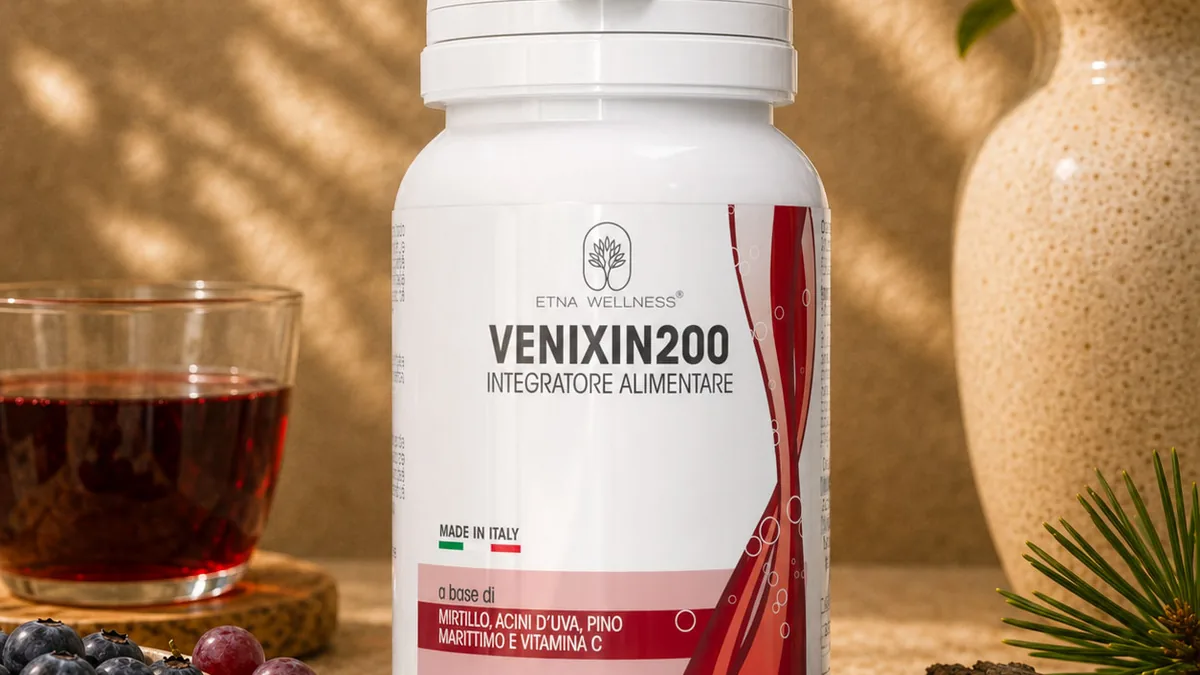
Venixin200 Etna Wellness: capsule-based formula with bilberry, grape seed, French maritime pine bark and vitamin C. — www.etnawellnesselitegroup.com
Venixin200 is a capsule supplement with a deliberately compact formula. Rather than relying on a long ingredient list, it concentrates on three standardised botanical extracts and vitamin C. That clarity can make the product easier to evaluate: you can see what is present, how much is declared and whether the formula matches the type of support you want from your daily routine.
The technical sheet positions the formula around antioxidant-oriented dry extracts, cardiovascular functionality, microcirculation and the feeling of heavy legs. That makes Venixin200 especially easy to place within a need-based decision: it is not a general multivitamin, but a more targeted option for people whose priority is this specific wellness area.
What you are actually taking in the 2-capsule daily serving
Component
Amount per 2 capsules
Additional note
Bilberry extract
60 mg
From Vaccinium myrtillus fruit, standardised to 25% anthocyanins
Grape-seed extract
100 mg
From Vitis vinifera seeds, standardised to 95% procyanidins
French maritime pine bark extract
15 mg
From Pinus pinaster bark, standardised to 65% OPCs
Vitamin C
60 mg
75% NRV
The ingredient list also includes vegetable food gelatine for the capsule shell, micronised silica, food maltodextrin and anti-caking agents (microcrystalline cellulose, pregelatinised corn starch and magnesium stearate). No extra active vitamins or minerals beyond vitamin C are declared in the current technical sheet.
What do these ingredients mean for the routine you are trying to build?
The formula becomes more useful when you connect it to the moment you notice the need. You are not choosing botanical names for their own sake; you are deciding whether this particular combination feels coherent with the kind of leg-care routine you want to maintain.
Venixin200 has a very recognisable structure. The formula combines three plant extracts that are often selected in supplements centred around antioxidant positioning and daily leg-comfort style routines, together with vitamin C. Because the technical sheet also declares the standardisation of the botanicals, the formula is easier to read than many generic labels.
Bilberry extract is declared from fruit and standardised to anthocyanins.
Grape-seed extract is declared from seeds and standardised to procyanidins.
French maritime pine bark extract is declared from bark and standardised to OPCs.
Vitamin C provides the clearest authorised EU health-claim framework for the product.
This matters both for accuracy and for the buying decision. The botanical extracts give Venixin200 its character, while vitamin C provides the clearest authorised physiological framework. Together, they create a formula that is easy to understand without relying on exaggerated promises.
Where vitamin C gives you a clear, evidence-based reference point
When a product sits close to a wellbeing need that can easily attract exaggerated promises, having one clear and authorised physiological reference can make the whole decision feel more grounded.
Under Regulation (EU) No 432/2012, vitamin C may be associated with several authorised health claims when the conditions of use are met. For Venixin200, the most relevant one is that vitamin C contributes to normal collagen formation for the normal function of blood vessels. The Regulation also includes vitamin C claims related to the protection of cells from oxidative stress and normal energy-yielding metabolism. See Regulation (EU) No 432/2012.
This authorised wording gives the product a clear and credible foundation: vitamin C supports a normal physiological function rather than promising a medical result. That distinction helps you evaluate Venixin200 with more confidence and less marketing noise. EFSA explains that health claims on foods must be scientifically assessed and authorised before they can be used. Read EFSA’s overview of health claims.
How should the botanical extracts be interpreted?
The botanical part of the formula should be approached with balance. The technical sheet itself frames the product around antioxidant properties and support-style positioning for circulation-related wellbeing and the sensation of heavy legs. At the same time, food-supplement communication should remain within a prudent boundary and avoid diagnostic or therapeutic language.
For that reason, this guide presents bilberry, grape seed and maritime pine bark as characterising ingredients of the formula, with declared standardisations that help you understand what the manufacturer chose to include. Italy’s Ministry of Health also frames botanical use in supplements within the broader regulatory framework for plant substances and preparations used in food supplements. See the Ministry page on botanical substances and preparations.
When Venixin200 may feel like the missing piece in your leg-care routine
Think about when you notice the need most: after commuting, a long shift, hours sitting, or an evening when your legs simply feel more present than you want them to. That recognition is what turns a generic supplement into a choice with a specific role.
There are days when your legs simply feel more demanding — after long periods standing, hours at a desk, travel or a routine that leaves little space for movement. In those moments, many people start comparing supplements not because they want a miracle solution, but because they want a clear, targeted option that fits easily into everyday life.
Venixin200 may be especially appealing if you prefer a focused formula with a simple 2-capsule daily routine, a small number of well-identified ingredients and no need to prepare powders or drinks. The formula is easy to understand: three standardised plant extracts plus vitamin C, with a 30-day bottle when used as directed.
That simplicity can increase the practical value of the product. Instead of asking “does it contain many ingredients?”, the more useful question becomes: does this formula match the specific support I am looking for, in a format I can realistically use every day?
The current technical sheet recommends 2 capsules per day, swallowed with a glass of water. The same sheet advises storing the product in a cool, dry place away from heat sources.
Because the bottle contains 60 capsules, a bottle lasts 30 days when used at the recommended daily serving. This is a direct pack calculation and should not be confused with an instruction to alter the dose.
Who may find this format useful?
Venixin200 may be worth comparing if you want:
a capsule format rather than a powder or drink;
a once-daily routine based on 2 capsules;
a formula with a small number of clearly declared active ingredients;
vitamin C included at 75% NRV;
a supplement positioned in a circulation- and leg-comfort related context, without moving into medicinal territory.
It may be less suitable if you prefer liquid formulas, want a broad multivitamin/mineral profile, or are looking for a completely different type of daily support. Venixin200 gains value when its focused formula matches your actual priority.
Before you make Venixin200 part of your routine, check the fit
A targeted product can feel reassuring, but the final decision should still take account of your individual situation, the label directions and anything else you already use.
The technical sheet states that the recommended daily dose should not be exceeded, the product should be kept out of reach of children under three years of age, and supplements should not be understood as substitutes for a varied, balanced diet and a healthy lifestyle.
Practical check: if you already use other vitamin C products or several supplements, review the full routine before adding another formula. A simpler, more coherent supplement plan is often easier to follow than stacking products without a clear reason.
Before you decide: a practical fit check
A useful decision is not about choosing the product with the strongest promise. It is about recognising whether the formula, daily routine and positioning match your real need. Use this short check before moving to the shop:
I want a capsule-based product, not a powder or a drink.
I am comfortable with 2 capsules per day.
I want a compact formula with bilberry, grape seed, maritime pine bark and vitamin C.
I understand that vitamin C provides the clearest authorised EU claim framework in the formula.
I am reading Venixin200 as a supplement for a specific routine, not as a treatment for a disease or vascular disorder.
I have checked my existing supplement routine so I am not duplicating products unnecessarily.
Bring the decision back to your day: when do your legs make you notice them most? If you can connect Venixin200 to a real, repeatable moment in your routine, the formula has a clearer purpose — and that is where perceived value becomes practical value.
If this kind of leg-care routine feels right for you, check Venixin200
Price, availability and market access can change. The most reliable route is to create your customer access first, then enter the official Etna Wellness shop and verify the current product page before ordering.
Open the customer-access route.
On mobile, scroll down and complete the customer-access details.
Enter the official shop after registration.
Search for Venixin200 and verify the current format, price and availability.
Complete your order only after confirming that the product matches your needs.
It is a food supplement positioned around a targeted combination of bilberry extract, grape-seed extract, French maritime pine bark extract and vitamin C. In practical terms, people often compare it within antioxidant-style and leg-comfort oriented supplement routines.
How many capsules do you take per day?
The current technical sheet states 2 capsules per day.
How long does one bottle last?
A bottle contains 60 capsules. At 2 capsules per day, that corresponds to 30 days of use.
How much vitamin C does Venixin200 provide?
The declared daily serving provides 60 mg vitamin C, corresponding to 75% NRV.
What botanical extracts does Venixin200 contain?
The current technical sheet lists bilberry fruit extract, grape-seed extract and French maritime pine bark extract, each with a declared standardisation.
Is Venixin200 a medicine?
No. It is presented as a food supplement, not a medicine.
Can Venixin200 replace a healthy diet?
No. The technical sheet explicitly states that supplements should not be intended as substitutes for a varied, balanced diet and a healthy lifestyle.
When Venixin200 fits your routine, the value becomes easy to recognise
The strength of Venixin200 is not complexity — it is clarity. You get a bottle with 60 capsules, a 2-capsule daily serving, three standardised plant extracts and 60 mg vitamin C. That makes the formula easy to understand and easy to compare.
For the right person, its value lies in being a focused supplement with a clear daily routine, a transparent formula and a specific leg-comfort / microcirculation positioning. If those characteristics match what you are looking for, Venixin200 becomes much easier to evaluate as a conscious purchase rather than an impulse choice.
Use the current label, exact serving, directions and suitability as your final confidence check. The best choice is the one whose formula and routine genuinely fit the need you recognise, without assuming that a broader or more complex product is automatically better.
Sources and verification
Exact pack size, serving instructions, ingredients, amounts and warnings in this guide are based on the current Venixin200 technical sheet used in the project source set. External sources are added only to frame compliant explanation of authorised claims and supplement context.
Current Venixin200 Etna Wellness technical sheet — primary source for 60 capsules, 12 g net weight, 2-capsule daily serving, ingredient list, standardisations, vitamin C quantity and warnings.
Independent distributor notice: this website is operated by an independent Etna Wellness distributor and is not the official corporate website. Product information is provided for general informational purposes and does not replace the current product label or professional medical advice. Food supplements should not be used as a substitute for a varied, balanced diet and a healthy lifestyle.
Sometimes the problem is not wanting to do more for yourself. It is that every extra bottle, scoop, dilution or preparation makes the routine harder to follow. You may start with good intentions and then realise that convenience is not a detail — it is what decides whether a habit survives a busy week.
If you like the idea of prickly pear but want something you can take without turning it into another daily task, the capsule format changes the experience completely.
If prickly pear interests you but a bottle, measuring cup or daily dilution does not fit your routine, Opucaps Etna Wellness offers a much simpler format: a food supplement in capsules made with dry extract from the cladodes of Opuntia ficus-indica.
Quick answer: the current official Etna Wellness page describes Opucaps as a 60-capsule supplement based on dry extract of Opuntia ficus-indica cladodes. Each capsule is listed as 400 mg and the directions are 2–3 capsules per day with a glass of water. The 400 mg figure is capsule-size information; this guide does not reinterpret it as a pure-extract dose.
Why simplicity can be the real reason to choose a capsule format
A product can look interesting on paper and still fail in real life if it is awkward to use. Opucaps has value when what you want is a compact routine: open the bottle, take the labelled serving with water and move on with your day.
What makes Opucaps different when convenience matters to you
Product type: food supplement.
Main ingredient: dry extract of prickly pear (Opuntia ficus-indica L. Mill.) from cladodes.
Pack: 60 capsules × 400 mg, 24 g net weight.
Recommended use: 2–3 capsules per day with a glass of water.
Made in Italy.
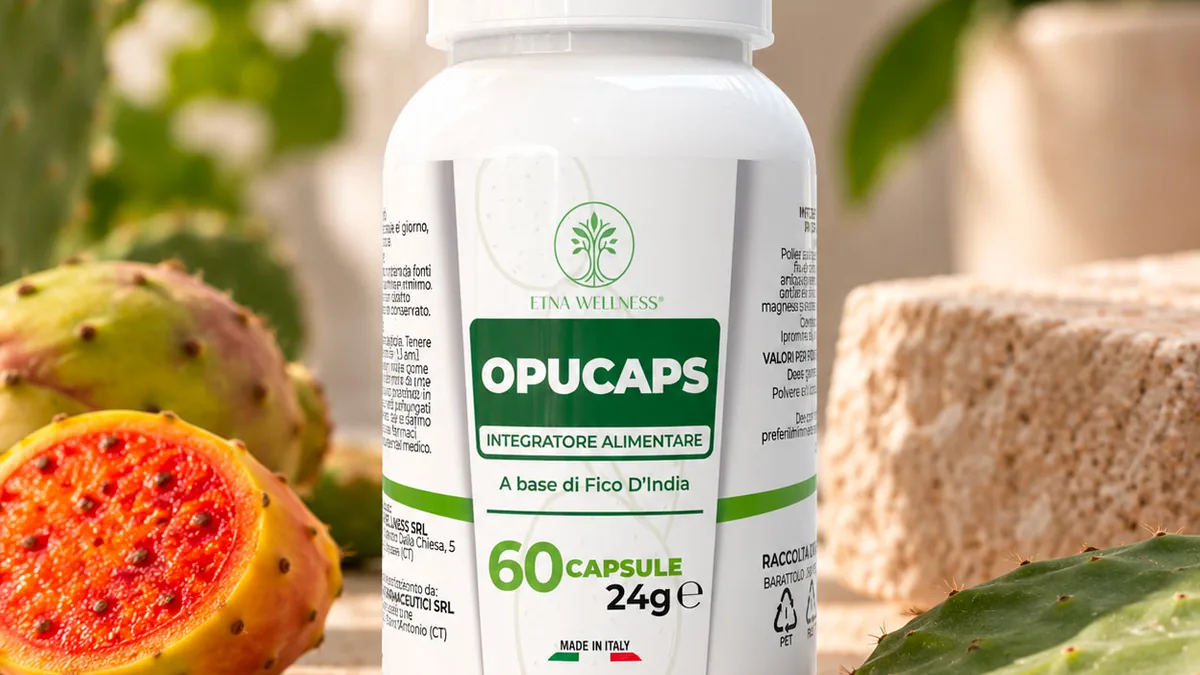
Opucaps Etna Wellness: 60 capsules with dry prickly pear extract from Opuntia ficus-indica cladodes. — www.etnawellnesselitegroup.com
If your goal is weight management, keep the product role separate from changes caused by fluid balance: Water Retention vs Weight Loss explains that distinction. If you are actually looking for a fibre-led daily routine rather than an Opuntia extract capsule, compare the K-Gel Etna Wellness guide.
Opucaps is a capsule-format supplement built around one botanical ingredient: dry extract of prickly pear cactus. The current official product page identifies the botanical as Opuntia ficus-indica L. Mill. and specifies that the extract comes from the cladodes.
This distinction matters because the cactus fruit, seeds, flowers and cladodes are different plant materials with different compositions. Opucaps should therefore be evaluated from the exact part of the plant and the exact dose declared for this product, rather than from general claims about “prickly pear”.
A short formula can be a strength — if it is the kind of simplicity you want
For some people, fewer moving parts make a product easier to understand and easier to trust. Here the question is not whether the list is long enough, but whether the main ingredient and format match the role you want the product to have.
The current official product page lists:
dry extract of prickly pear (Opuntia ficus-indica L. Mill. — cladodes);
microcrystalline cellulose;
pregelatinised starch;
maltodextrin;
magnesium stearate.
The practical advantage of a simple ingredient list is transparency: you can see immediately that the product is centred on one botanical extract rather than a multi-ingredient blend.
What are cladodes?
Cladodes are the flattened green pads of the cactus. They are stems adapted to store water, not the ripe prickly pear fruit. A detailed scientific review of Opuntia ficus-indica describes cladodes as a plant material containing carbohydrates, fibre, minerals and mucilage, while also stressing that composition varies with cultivar, maturity and growing conditions. Read the peer-reviewed review on the composition of Opuntia ficus-indica cladodes.
That background helps explain why cladodes are studied as a botanical and food ingredient. It does not mean that every property reported for whole cladodes, foods or experimental extracts can automatically be attributed to Opucaps.
What does the 400 mg capsule figure tell you?
The current official product page describes a pack of 60 capsules of 400 mg, with a total net weight of 24 g, and recommends 2–3 capsules per day with water.
The 400 mg figure describes the capsule size shown in the current official product information. Because the ingredient list also includes excipients, this guide does not reinterpret that figure as 400 mg of pure prickly pear extract per capsule and does not calculate an unverified daily extract total.
The current official product page gives a simple direction: take 2–3 capsules per day with a glass of water.
It does not specify an exact number of minutes before a meal, a compulsory meal, or a morning/evening schedule. For that reason, this guide does not invent a timing rule that is not present on the product information.
How long does one pack last?
A bottle contains 60 capsules. At two capsules per day, it lasts approximately 30 days. At three capsules per day, it lasts approximately 20 days. This is one of the clearest practical differences to consider when choosing where within the 2–3 capsule direction your routine sits.
No. The product sheet positions Opucaps around body-weight balance and nutrient absorption, but that should not be translated into a promise that the finished product causes weight loss.
A systematic review and meta-analysis of randomised clinical trials on Opuntia ficus-indica found no statistically significant overall effect on body weight, while noting that the available trials were few and heterogeneous. See the PubMed systematic review and meta-analysis.
A more recent review similarly concludes that findings depend strongly on the specific preparation, dose and study design. See the 2024 review on Opuntia and metabolic outcomes. Neither paper studied Opucaps itself, so they should be used to understand the ingredient evidence — not to predict an individual result from this product.
What about nutrient absorption?
Research on certain specialised cactus-fibre complexes has investigated fat binding and nutrient-related mechanisms. Those studies use specific preparations that are not automatically equivalent to the dry extract in Opucaps. For that reason, this article does not transfer results from proprietary fibre complexes to the finished product.
The useful distinction is simple: formula fact is not the same as clinical outcome. The label tells you what Opucaps contains and how much to take; clinical research tells you what has been studied in other preparations and under what conditions.
Opucaps capsules vs liquid Opuntia products
Capsules are not “better” than liquids in absolute terms. They solve a different practical problem. Opucaps removes measuring, dilution and flavour from the routine, while liquid products may appeal to people who prefer a drinkable format.
Choose capsules if: portability, pre-portioned use and simplicity matter most.
Choose a liquid format if: you prefer drinking the product and are comfortable measuring a serving.
Do not compare only by milligrams: dry extract and juice/concentrate are different preparations and should not be treated as interchangeable gram-for-gram.
Before you add Opucaps to your routine, check the essentials
Convenience is valuable, but it should never replace a sensible check of the label, serving and warnings. A routine feels better when you know why the product is there and how it is meant to be used.
The current official product page says to store Opucaps in a cool, dry place away from heat sources and notes that the expiry date refers to the intact product when correctly stored. Follow the serving and warning instructions shown on the current pack, do not exceed the recommended daily amount, and keep food supplements within the wider context of a varied, balanced diet and healthy lifestyle.
If you take medication, have a diagnosed condition, are pregnant or breastfeeding, or have concerns about gastrointestinal tolerance, ask an appropriate healthcare professional before use. Research on Opuntia preparations is not a substitute for personalised medical advice.
Before you decide: can you genuinely see this fitting your day?
Picture the version of the routine you are most likely to keep. If you prefer a capsule you can take quickly rather than a product you have to mix or measure, that practical fit may matter more than a long list of promises.
I prefer capsules to a liquid botanical product.
I am comfortable taking 2–3 capsules per day with water.
I understand that the extract comes from cladodes, not the fruit pulp.
I have checked the ingredient list and warnings.
I am not expecting guaranteed weight loss.
I understand that evidence on other Opuntia preparations cannot automatically be transferred to Opucaps.
Your decision can be simple too: if you prefer a compact capsule routine and you value knowing the declared prickly-pear amount before you buy, Opucaps has a clear reason to be on your shortlist.
If simplicity is what you want, here is how to check Opucaps
Current price, stock and country availability can change. The safest route is to create customer access, enter the official Etna Wellness shop and verify the current product information for your market.
Create your customer access.
Enter the official Etna Wellness shop.
Search for Opucaps.
Check the current format, price and availability.
Complete the order only if the product still fits your needs.
It is a food supplement containing dry extract of prickly pear (Opuntia ficus-indica) from cladodes.
How many capsules are in one pack?
There are 60 capsules of 400 mg, for a total net weight of 24 g.
How many capsules should you take?
The current official product page recommends 2–3 capsules per day with a glass of water.
Does the current page state the exact daily amount of prickly pear extract?
No separate milligram amount for pure prickly pear extract per daily serving is published on the current official product page. It states the 400 mg capsule size, the ingredient identity and the 2–3 capsule daily directions.
Does Opucaps use the prickly pear fruit?
The current ingredient list identifies the cladodes, the flattened green cactus pads, rather than the ripe fruit pulp.
How long does a bottle last?
Approximately 30 days at 2 capsules per day or 20 days at 3 capsules per day.
Does Opucaps guarantee weight loss?
No. It should not be presented as a guaranteed weight-loss product. Research on Opuntia ficus-indica varies by preparation and study design, and the finished Opucaps product has not been shown in the sources used here to guarantee weight loss.
Where can I check the current price?
Use customer access to enter the official Etna Wellness shop and verify the current price and availability for your country before ordering.
If simplicity is the reason you are interested, let that guide the decision
Opucaps is easy to understand when you separate the product facts from the marketing expectations: dry prickly pear extract from cladodes, 60 capsules of 400 mg and a 2–3 capsule daily direction.
The strongest reason to choose it is not that capsules are universally superior. It is that this format may make a prickly-pear routine easier to maintain for someone who values portability and pre-portioned use.
Use the current label, exact serving, directions and suitability as your final confidence check. The best choice is the one whose formula and routine genuinely fit the need you recognise, without assuming that a broader or more complex product is automatically better.
Sources and verification
Current product identity, ingredient declaration, capsule count, capsule size, directions and storage information in this guide are based primarily on the current official Etna Wellness Opucaps product page. External sources are used only to provide botanical and evidence context; they do not prove a medical or weight-loss effect for the finished product.
Independent distributor notice: this website is operated by an independent Etna Wellness distributor and is not the official corporate website. Product information is provided for general informational purposes and does not replace the product label or professional medical advice. Food supplements should not be used as a substitute for a varied, balanced diet and a healthy lifestyle.
There are days when your legs seem to tell you exactly how long the day has been. Hours sitting, hours standing, heat, travel, a rushed routine — by the evening you may feel less light, less comfortable and more aware of your body than you would like.
That is often when you start wanting something simple you can actually keep doing every day: not a complicated ritual, but a small action that feels consistent with the way you want to take care of yourself.
Some supplement choices start with a very practical feeling: your legs feel heavy, your routine feels inconsistent, or you simply want a drinkable product that is easy to use every day. If that is why CelluTea Etna Wellness caught your attention, the useful question is not whether it sounds “strong”, but whether its format, ingredients and daily use actually fit what you are looking for.
Quick answer: CelluTea is a 120 g water-soluble food supplement. The current official product page recommends one scoop per day in 500 ml of still water. The current ingredient declaration lists bromelain, Centella asiatica extract standardised to 2% total triterpene derivatives, green tea extract standardised to 5% caffeine, and red grape seed extract standardised to 95% procyanidins.
Why the drinkable format can change the way the routine feels
If another capsule feels like “one more thing to remember”, a drink can create a very different experience. You prepare it, keep it with you and turn the product into a visible part of the day. For some people, that makes consistency feel easier — and consistency is what gives any routine a chance to become real.
What makes CelluTea easy to picture in a real day
Format: 120 g.
How to prepare it: 1 scoop in 500 ml of still water.
Main characterised ingredients: bromelain, Centella asiatica, green tea and red grape seed extract.
Use pattern: drinkable daily supplement rather than capsules.
Caffeine: green tea extract is standardised to 5% caffeine. The current public product page does not state a per-serving caffeine amount, so this guide does not infer one.
This format matters. For some people, a supplement that becomes part of a 500 ml drink is easier to integrate into the day than another capsule or tablet. For others, it may simply not be the most convenient format. The right choice depends on the role you want the product to have in your routine.
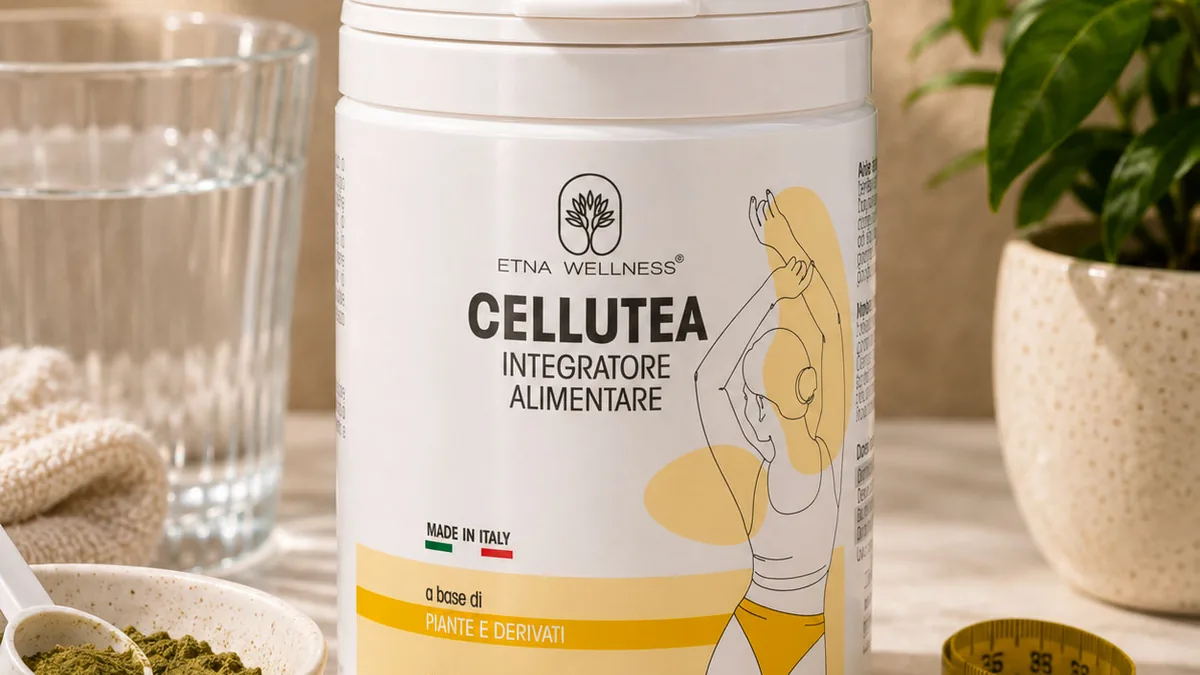
CelluTea Etna Wellness: 120 g drinkable food supplement. — www.etnawellnesselitegroup.com
The current official product page presents CelluTea in the context of the appearance of cellulite, microcirculation and the sensation of heavy legs. Those are the product-positioning areas that explain why Centella, green tea and red grape seed appear together in the formula.
That positioning should not be interpreted as a guaranteed cosmetic result, a treatment for a circulatory disorder or a promise of automatic fluid loss. A better way to evaluate CelluTea is to ask whether you want a drinkable botanical supplement that fits into a routine centred on leg comfort, hydration habits and body-care awareness.
What you are actually putting into your daily drink
Once CelluTea becomes part of a daily ritual, the formula deserves more than a quick glance. The ingredient declaration and standardisations help you understand what makes the product different and whether that difference feels relevant to you.
The current official product page gives the following formula details:
Ingredient
Current official formula detail
Bromelain (Ananas comosus)
Listed in the current ingredient declaration
Centella asiatica dry extract
Standardised to 2% total triterpene derivatives
Green tea dry extract
Standardised to 5% caffeine
Red grape seed extract
Standardised to 95% procyanidins
The ingredient list also includes crystalline fructose, food-grade maltodextrin and flavourings. This is useful to know if you are comparing CelluTea with capsule-based products, because the delivery format is part of the product itself.
How to read the formula without turning hope into a promise
It is easy to see familiar botanicals and mentally jump straight to the result you want. A better decision comes from staying close to what is genuinely supported while still asking whether the overall formula feels coherent with your goal.
A multi-ingredient formula can look persuasive simply because several familiar botanical names appear together. But a good decision needs more than an ingredient list.
There are three separate questions to keep apart:
What is actually in the product? The current product information answers this with the declared ingredients, standardisations and directions for use.
What claims may legally be made for an ingredient in a specific market? This depends on the applicable nutrition and health-claims framework.
What will the finished product do for you personally? That cannot be guaranteed from the ingredient list alone.
This distinction is especially important around words such as “drainage”, “cellulite”, “circulation” and “weight loss”. CelluTea should be evaluated from its documented formula and intended routine, not from exaggerated interpretations of those terms.
Bromelain: what the current formula confirms
The current official ingredient declaration confirms bromelain from pineapple stem. The public product page does not state a per-serving milligram amount, so the useful comparison is the declared ingredient identity, the overall formula and the current directions for use.
Centella, green tea and red grape seed: what they add to the formula
The current official formula lists Centella asiatica extract standardised to 2% total triterpene derivatives, green tea extract standardised to 5% caffeine and red grape seed extract standardised to 95% procyanidins. These are formula facts; they do not establish a guaranteed cosmetic, circulatory or weight-management outcome.
The current official product page recommends one scoop per day dissolved in 500 ml of still water.
It also states that the product should be stored in a cool, dry place away from heat sources, and that the best-before date refers to the intact product when correctly stored.
The current official pack size is 120 g. Follow the scoop and preparation directions shown on the current product label.
Does CelluTea contain caffeine?
Yes. The current official ingredient declaration lists green tea extract standardised to 5% caffeine. The public product page does not publish a per-serving caffeine amount, so this guide does not calculate one.
CelluTea vs Tea Dren Mix: do they have the same role?
No. CelluTea and Tea Dren Mix sit in a related area of the Etna Wellness range, but they should not be treated as interchangeable just because both are drinkable products.
CelluTea has its own formula and product positioning, with bromelain, Centella, green tea and red grape seed. Tea Dren Mix has a separate composition and should be evaluated according to its own current product information and intended role.
If you are choosing between them, compare formula, timing, format and the specific need you are trying to address rather than assuming that the product with the strongest-sounding name is automatically the better fit.
What CelluTea can realistically add to the way you care for your legs
Think of the value in layers: first the ritual of preparing the drink, then the fact that the formula has a defined daily serving, then the confidence of knowing exactly which botanical ingredients you are using. That does not create a guaranteed cosmetic result — but it can make the routine feel more intentional and easier to maintain.
CelluTea gives you a clearly defined daily format: one scoop in 500 ml of water and a documented set of botanical ingredients.
That makes it potentially useful for someone who prefers a drinkable supplement and wants a structured daily action within a broader body-care or leg-comfort routine.
What it should not become is a shortcut narrative. It is not reasonable to present one supplement as a guaranteed solution for cellulite, fluid retention, circulation or weight loss. The value of the product comes from whether its formula and format make sense within your broader habits.
Before you make CelluTea part of your day, check the practical details
The right product is not simply the one that sounds attractive; it is the one that fits your routine, your preferences and your individual circumstances without adding avoidable uncertainty.
The current official product page advises following the pack directions and not exceeding the recommended daily amount. Its FAQ also recommends checking with a healthcare professional when medicines are being used and consulting a doctor during pregnancy.
As with food supplements generally, the product should not be treated as a substitute for a varied, balanced diet and a healthy lifestyle.
If you take medication, have a diagnosed condition, are particularly sensitive to caffeine or are unsure whether a botanical supplement is suitable for you, ask an appropriate healthcare professional before use.
Before you decide: a quick fit check
I prefer a drinkable daily supplement rather than capsules.
I am comfortable preparing 500 ml of still water each day.
I understand the formula details and the current preparation instructions.
I have checked the warnings that apply to me.
I am not expecting an automatic cosmetic or weight-loss result.
I can identify a clear role for CelluTea in my routine.
Picture the routine, not just the tub: one scoop, your bottle of water, one daily gesture that feels easy enough to repeat. If that image feels natural to you, the product is already solving an important part of the decision — practical fit.
If you can see CelluTea fitting your day, check the current product here
Price, stock, market availability and checkout conditions can change. For that reason, the safest buying path is to create customer access and verify the current product information inside the official Etna Wellness shop for your country.
Create your customer access.
Enter the official Etna Wellness shop.
Search for CelluTea.
Check the current format, price and availability.
Complete the order only if the product still fits your needs.
CelluTea is a 120 g water-soluble food supplement. Its current ingredient declaration includes bromelain, Centella asiatica, green tea and red grape seed extract.
How do you take CelluTea?
The current official product page recommends one scoop per day in 500 ml of still water.
Does CelluTea contain bromelain?
Yes. Bromelain from pineapple stem is listed in the current official ingredient declaration. The public product page does not state a per-serving milligram amount.
Does CelluTea contain caffeine?
Yes. The current official ingredient declaration lists green tea extract standardised to 5% caffeine. A per-serving caffeine amount is not stated on the public product page.
What is the current pack size?
The current official product page lists a 120 g format. Follow the current scoop and use instructions on the label.
What if I am pregnant or breastfeeding?
The current official FAQ advises consulting a doctor before use during pregnancy. For pregnancy or breastfeeding, use the current label and appropriate professional advice rather than assuming suitability.
Is CelluTea the same as Tea Dren Mix?
No. They have different formulas and should be evaluated as separate products. See our Tea Dren Mix guide for its own ingredients and role.
Does CelluTea make you lose weight?
CelluTea should not be presented as a guaranteed weight-loss product. Its formula and drinkable format can be evaluated within a broader routine, but body-weight change depends on many factors and should not be promised from this supplement alone.
Where can I check the current CelluTea price?
Create customer access, enter the official shop and verify the current price and availability for your market before ordering.
The right choice should feel clear before you reach the shop
CelluTea is easier to evaluate when you strip away exaggerated expectations. You know the format, the daily amount, the ingredient quantities, the caffeine declaration and the main warnings.
That puts you in a better position to decide whether a drinkable botanical supplement belongs in your routine — and, just as importantly, whether it does not.
Use the current label, exact serving, directions and suitability as your final confidence check. The best choice is the one whose formula and routine genuinely fit the need you recognise, without assuming that a broader or more complex product is automatically better.
Sources and verification
Product identity, ingredient standardisations, pack size and preparation instructions in this guide are aligned to the current official Etna Wellness CelluTea product page. Older quantitative technical-sheet values are not presented as current public-label facts. External references below are used only for ingredient-level, botanical or caffeine context. They do not replace the product label and should not be read as proof that CelluTea delivers a medical, cosmetic or weight-loss outcome. Current prices, stock and country availability should always be checked inside the official Etna Wellness purchasing environment.
Etna Wellness — current CelluTea product page — official range reference; current CelluTea formula and preparation details in this article remain anchored to the current official product page.
Independent distributor notice: this website is operated by an independent Etna Wellness distributor and is not the official corporate website. Product information is provided for general informational purposes and does not replace the product label or professional medical advice. Food supplements should not be used as a substitute for a varied, balanced diet and a healthy lifestyle. If you have a medical condition, take medication, are pregnant or breastfeeding, seek appropriate professional advice before using supplements.
You can do everything “right” during the day and still find that the evening is where the routine starts to loosen. Dinner is over, the pace drops, tiredness sets in, and suddenly the discipline that felt easy at 10 a.m. feels much harder to protect.
If you are trying to manage your weight, that moment matters because it is not only about food or supplements. It is about wanting to finish the day feeling that you are still moving in the direction you chose for yourself — not starting again from zero tomorrow.
There is a particular moment in many weight-management routines when good intentions become harder to hold on to: the evening.
The day slows down, energy drops, habits become less structured, and it is easy to start looking for something that feels simple, practical and reassuring. If that is why Burn Night Etna Wellness caught your attention, the most useful thing you can do is not rush the decision.
Instead, look at the product the way you would want any good advisor to present it to you: what it contains, when it is taken, what role it can realistically have, what the label does and does not support, and whether that role actually fits your routine.
Quick answer: Burn Night is an evening-oriented food supplement in capsules. The recommended daily intake is two capsules after dinner or before going to bed. Its formula includes botanical extracts, acetyl L-carnitine, choline, magnesium, vitamin C and vitamin B6, with bitter orange extract standardised to 26% synephrine. The name “Night” describes its timing; it should not be interpreted as a guarantee of weight loss during sleep.
If, after understanding the formula and the warnings, Burn Night still feels aligned with what you are looking for, you can then move to the practical step: check current availability, price and country conditions in the official shop before deciding.
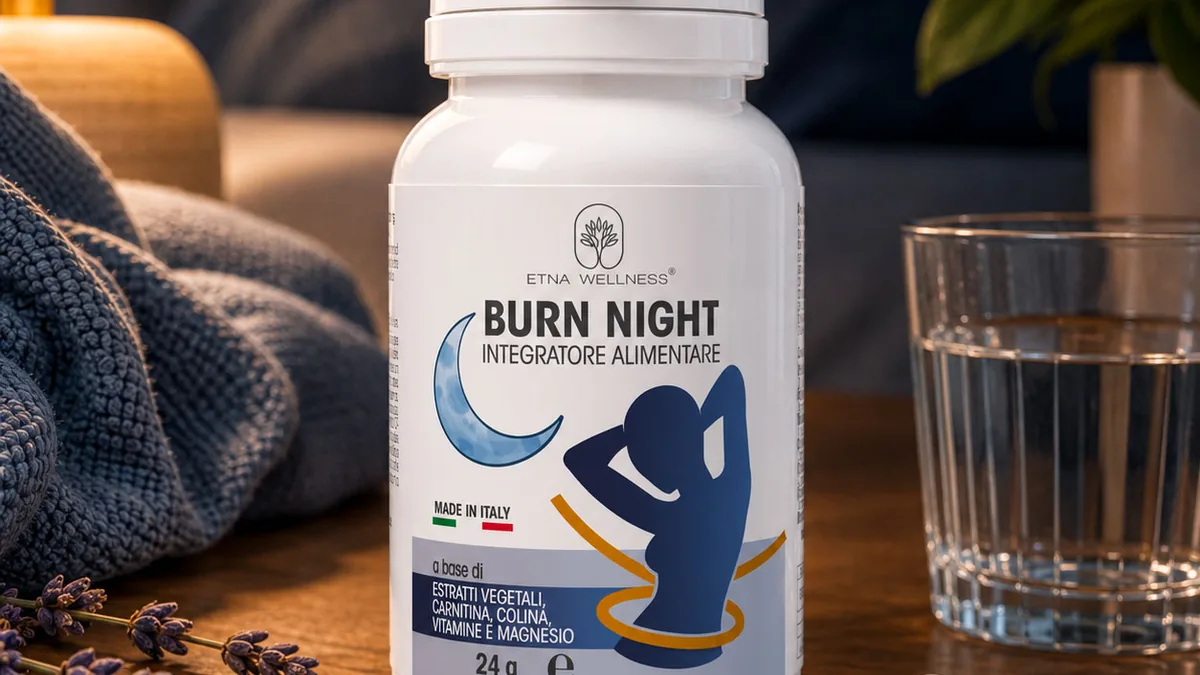
Burn Night Etna Wellness: evening supplement in capsules. — www.etnawellnesselitegroup.com
Before the formula: what you may really be looking for at night
Maybe what you want is not “another fat burner”. Maybe you want the evening to stop feeling like the weak point of the day. You want a routine that is simple enough to repeat, clear enough to trust and specific enough to have its own place.
What you need to know before Burn Night earns a place in your evening
Format: 60 capsules.
Recommended daily amount: 2 capsules.
When to take it: after dinner or before going to bed.
Approximate pack duration: 30 days at the recommended daily dose.
Bitter orange: extract standardised to 26% synephrine in the current official formula.
Position in the routine: evening-oriented supplement.
This is the first important distinction. Burn Night is not valuable because its name sounds dramatic. Its value has to come from whether the formula, timing and practical fit make sense for you.
What need is Burn Night designed to fit?
Burn Night is best understood as a product for someone who wants an evening component within a structured supplement routine.
That does not mean you need an evening supplement simply because you are working on weight management. It means that, if evening is the point where you want your routine to feel clearer and more consistent, Burn Night gives you a defined format: two capsules, taken after dinner or before bed.
The decision becomes more useful when you stop asking “Is this strong?” and start asking:
Does an evening format suit the way I organise my day?
Do I understand the ingredients and their amounts?
Have I checked the warnings that apply to me?
Does this product add a distinct role, rather than simply duplicating something I already use?
That is the difference between adding another product and building a routine with intention.
What is inside Burn Night — and why that matters to your decision
The current official Etna Wellness product page describes Burn Night as a food supplement based on plant extracts, carnitine, choline, vitamins and magnesium. Its ingredient list includes Garcinia cambogia extract, acetyl L-carnitine HCl, bitter orange extract, milk thistle, magnesium, vitamin C, fennel, lemon balm, mallow, red vine, choline bitartrate and vitamin B6.
For comparison purposes, the most useful current label details are the declared botanical standardisations. Bitter orange extract is listed at 26% synephrine, Garcinia cambogia at at least 60% hydroxycitric acid, milk thistle at at least 80% silymarin, lemon balm at 4% rosmarinic acid and red vine at 5% total polyphenols.
The current public product page does not publish a complete milligram breakdown for the daily serving. For that reason this guide does not present unverified per-ingredient milligram amounts as current label facts.
How to turn the ingredient list into a smarter buying decision
This is where many people either overestimate a product or dismiss it too quickly. The better approach is to separate what is documented from what is merely suggested by a name or a familiar ingredient.
When a supplement contains several ingredients, it is easy to mentally add together every benefit you have ever heard associated with each one. That is not a reliable way to evaluate a finished product.
A stronger approach is to separate three levels:
Product facts: what is actually in Burn Night and in what amount.
Ingredient or nutrient claims: wording that may be authorised when the relevant legal conditions are met.
Finished-product promises: statements about what Burn Night itself will do for you.
Those levels are not interchangeable. The presence of an ingredient does not automatically justify every claim connected with it, and an ingredient-level claim should not be expanded into a guaranteed result for the finished product.
This is especially important for weight-management products, where phrases such as “burns fat while you sleep”, “guarantees weight loss” or “accelerates metabolism overnight” can sound powerful but go well beyond what should be inferred from the product name or timing alone.
Why is it called Burn Night?
The clearest documented answer is straightforward: because it is used in the evening.
The recommended intake is two capsules after dinner or before going to bed. That makes Burn Night easy to distinguish from products intended for a different moment of the day.
And that distinction is useful. It allows you to evaluate the product for what it actually is, rather than for what the word “Night” might make you imagine.
Evening timing is a product fact. Automatic fat burning during sleep is not.
Would you like help checking Burn Night ingredients, usage directions and precautions? Request current Etna Wellness product information before deciding. Always consult the current product label and availability in your country.
How and when to take Burn Night
The current official product page recommends 2 capsules per day, after dinner or before going to bed.
At this dose, a pack of 60 capsules provides approximately 30 days of use.
Do not exceed the recommended daily amount. If you are already using other supplements, compare their formulas and roles before combining products. A better routine is not necessarily the one with the greatest number of products; it is the one in which each product has a clear and appropriate purpose.
Bitter orange and synephrine: the detail you should not overlook
The current official ingredient list includes bitter orange (Citrus aurantium) dry extract standardised to 26% synephrine. That standardisation is useful when comparing formulas because it tells you more than the plant name alone.
The current public product page does not state the milligram quantity of bitter orange extract or synephrine per daily serving, so this article does not calculate or imply a precise daily synephrine amount.
If you use medicines, have a medical condition, are pregnant or breastfeeding, or are considering combining several supplements, check suitability with an appropriate healthcare professional before use.
Burn Night vs Burn Plus: which role fits your routine?
Burn Night and Burn Plus belong to the same broad product area, but they are not interchangeable.
The clearest difference is timing and formula. Burn Night is explicitly positioned for evening use, while Burn Plus has a different composition and a different place in the day.
So the useful question is not “Which is stronger?” but:
Which product has the role that is actually missing from my routine?
If your main concern is not timing but another part of the weight-management routine, it may be more useful to understand how Control Plus is positioned, or to review the separate AC Plus guide.
These links are there to help you compare roles before buying, not to suggest that all products should be used together.
What Burn Night can realistically add to your evening routine
The value becomes easier to feel when you picture the role, not the promise: dinner is finished, you know exactly when the product belongs in your day, you know the dose, and you are not improvising. That sense of structure is often more useful than chasing a dramatic claim.
There is a more convincing way to look at Burn Night than expecting a dramatic overnight result.
You are looking at a product with:
a clearly defined evening timing;
a documented daily dose;
clearly identified ingredients and declared botanical standardisations;
a declared bitter-orange standardisation of 26% synephrine, without an inferred per-serving synephrine amount;
specific safety warnings that can be checked before use.
That may sound less spectacular than a promise about “burning fat while you sleep”, but it gives you something much more valuable: a decision you can understand and defend to yourself.
If what you want is a shortcut that works independently of diet, lifestyle and the rest of your routine, Burn Night should not be interpreted that way.
If what you want is a defined evening supplement and you value knowing what you are taking before you buy, then Burn Night gives you concrete information to evaluate.
Before you make it part of your evening, check these points
A product only adds value when it fits you safely as well as practically. This is the point to slow down for a moment and make sure enthusiasm is matched by a sensible check.
The current public product information should be read together with the label and warnings supplied with the pack. Do not exceed the recommended daily amount, and check suitability with a healthcare professional when medicines, medical conditions, pregnancy or breastfeeding are relevant.
If you take medication, have a diagnosed condition or already use supplements containing stimulating botanicals, professional advice is particularly important before adding another product.
Safety information should not reduce the value of a product in your eyes. The opposite is true: the more clearly you understand both the formula and its limits, the more confidently you can decide whether it belongs in your routine.
Before you decide: a 30-second fit check
Burn Night may be worth evaluating if you can answer “yes” to these questions:
I am specifically looking for an evening-oriented supplement.
I understand the recommended dose and timing.
I have checked the bitter-orange standardisation, the full formula and the warnings.
I understand that the product name is not a guarantee of weight loss during sleep.
I can identify a distinct role for Burn Night in my routine.
If one or more answers are “no”, that is useful information too. A good purchase decision is not about convincing yourself to buy; it is about becoming clear enough to know whether the product genuinely fits.
One final question before you move to the shop: are you choosing Burn Night because the evening is genuinely the point where you want more structure — or simply because the name sounds stronger? If the first is true, you now have enough information to check the product with a clear reason in mind.
If Burn Night feels right for your evening, here is the next step
Price, promotions, country access and stock can change. For that reason, this page does not lock you into a price that may later be outdated.
The buying path is simple:
Create your customer access.
Enter the official Etna Wellness shop.
Check Burn Night availability for your country.
Review the current price and checkout conditions.
Complete the order only if the product still fits what you are looking for.
Burn Night is an evening food supplement in capsules containing botanical extracts, acetyl L-carnitine, choline, magnesium, vitamin C and vitamin B6.
How many Burn Night capsules should I take?
The current official product page recommends 2 capsules per day, after dinner or before going to bed.
What does the current label say about synephrine?
The current official formula lists bitter orange dry extract standardised to 26% synephrine. The public product page does not state a per-serving synephrine amount, so this guide does not infer one.
Does Burn Night burn fat while you sleep?
The product has documented evening timing, but that timing does not by itself establish that it burns fat during sleep. The formula, dose, warnings and intended role are more useful points to evaluate than an exaggerated interpretation of the product name.
Is Burn Night the same as Burn Plus?
No. They differ in formula and timing. Burn Night is specifically used after dinner or before bed. See the dedicated Burn Plus guide for its composition and use.
How long does one pack last?
At the recommended dose of 2 capsules per day, a 60-capsule pack provides approximately 30 days of use.
What if pregnancy, breastfeeding, medicines or a medical condition are relevant?
Check the current pack warnings and ask an appropriate healthcare professional before use rather than relying on a general online guide.
Where can I check the current Burn Night price?
The safest approach is to create customer access, enter the official shop and verify the current product, price and availability for your country before ordering.
When Burn Night makes sense, you should be able to explain why
By this point, you know what Burn Night contains, when it is taken, how its bitter-orange extract is standardised, where it differs from Burn Plus, and which warnings deserve attention.
That is where the real value of the decision changes.
You are no longer choosing because a name sounds attractive. You are choosing because you understand the role the product could have in your routine and you can decide whether that role is useful to you.
If Burn Night still feels aligned with what you are looking for, the next step is simply to verify the current conditions in the official shop and make the decision with the complete information in front of you.
Use the current label, exact serving, directions and suitability as your final confidence check. The best choice is the one whose formula and routine genuinely fit the need you recognise, without assuming that a broader or more complex product is automatically better.
Sources and verification
Product identity, qualitative formula, ingredient standardisations and recommended use in this guide are aligned to the current official Etna Wellness Burn Night product page. Older quantitative values are not treated as current-label facts unless independently current-locked. Nutrition and health wording must also comply with the rules applicable in the customer’s market.
Independent distributor notice: this website is operated by an independent Etna Wellness distributor and is not the official corporate website. Product information is provided for general informational purposes and does not replace the product label or professional medical advice. Food supplements should not be used as a substitute for a varied, balanced diet and a healthy lifestyle. If you have a medical condition, take medication, are pregnant or breastfeeding, seek appropriate professional advice before using supplements.
If the scale changes quickly, the first useful question is not “which weight-loss product should I add?” but “am I looking at body fat, fluid balance or something else?”
Water retention and fat loss are often mixed together in marketing, yet they are not the same process. A drainage-oriented route may be relevant when the need is temporary fluid balance or a feeling of puffiness, while a structured weight-management route answers a different question.
If someone interprets every short-term scale increase as fat gain, it becomes easy to choose the wrong type of product. The reverse is also true: a temporary drop in water weight can look like “weight loss” without representing a reduction in body fat.
That is why the most useful comparison begins with the underlying need rather than the most persuasive label.
Water retention: what the scale may be showing
Body water can fluctuate for many everyday reasons, including dietary patterns, salt intake, menstrual cycle changes, travel, heat, activity and other factors. These shifts may affect scale weight without reflecting a meaningful change in body-fat mass.
A drainage-oriented supplement should therefore be understood as a fluid-balance route, not a shortcut to fat loss.
Weight management is a different objective
A structured weight-management route generally focuses on a broader routine: meal structure, energy intake, food choices, movement, adherence and, where appropriate, products designed for that specific role.
That is different from trying to influence temporary water balance.
Products such as Shake Plus, Burn Plus or Control Plus belong to their own exact product owners and should not be reframed as drainage products. Likewise, Tea Dren Mix should not be presented as a fat-burning or weight-loss treatment.
Drainage products should not inherit weight-loss claims
The fact that a drainage product may be used in a body-composition journey does not mean the drainage action itself represents fat loss.
This distinction protects the customer from a common decision error: assuming that a faster change on the scale is automatically a better weight-management result.
Where Tea Dren Mix fits
Tea Dren Mix belongs to the drainage / fluid-balance route. It can be considered when the actual decision is about drainage rather than fat loss.
Its exact product information remains with the dedicated Tea Dren Mix owner. This comparison page does not convert it into a weight-loss product and does not claim that it treats oedema.
Where structured weight-management routes fit
If the real objective is a longer-term change in body weight or body composition, the decision should move away from drainage and towards a structured weight-management framework.
That may include meal structure, appetite-related decision support, lifestyle consistency and products whose verified role belongs to the weight-management route.
The useful question becomes: “What routine can I follow consistently?” rather than “How can I make the scale move fastest?”
For a product-specific evening weight-management route, the Burn Night guide keeps timing, formula and safety information separate from drainage claims.
If you are comparing a prickly-pear capsule route instead, the Opucaps guide covers its current formula, serving and evidence limits without treating temporary fluid change as fat loss.
Why stacking drainage and weight products is not automatic
It is easy to assume that combining more products must create a stronger result. That is not a sound decision rule.
A drainage product and a weight-management product answer different needs. They should only appear together when both needs are genuinely present and each product has a distinct role.
If the only need is fluid balance, adding several weight products creates unnecessary complexity. If the only need is weight management, adding drainage solely to make the scale move faster can create the wrong expectation.
More products do not automatically mean more value
Perceived value should come from fit, clarity and a routine that makes sense. A larger stack is only more valuable when each additional product solves a separate problem that has actually been identified.
That is the basis of ethical upselling: second need first, second product second.
Picture the next four weeks, not the next morning
Imagine checking the scale tomorrow after a change in fluid balance. The number may move, but that single reading tells you little about body-fat change.
Now imagine the next four weeks. Which routine would still make sense after the first few days: a temporary drainage focus, or a structured approach that you can repeat consistently?
Future routine is a better decision criterion than short-term scale excitement.
A six-question fit check
Is my main concern temporary puffiness/fluid balance or longer-term weight management?
Am I interpreting a short-term scale change as body-fat change?
Does the product belong to a drainage route or a weight-management route?
Is each product in the routine solving a distinct need?
Am I expecting drainage to “burn fat” or create permanent weight loss?
Can I explain the routine in a simple, realistic way?
Choose the route before you choose the products
If you are unsure whether your priority is drainage, weight management or another need, start from the Needs Guide. If the goal is weight management, use the dedicated configurator rather than treating drainage as a fat-loss shortcut.
Want help before registering? Request guided customer access. This internal request is optional; it does not create an official account or place an order.
Creating customer access does not place an order. On mobile, scroll down on the registration page, complete your customer details, enter the shop and verify the current product, format, price and availability before ordering.
Frequently asked questions
Can water retention make the scale go up?
Yes. Changes in body water can affect scale weight. That does not mean the same amount of body fat has been gained.
If drainage lowers the scale, have I lost fat?
Not necessarily. A short-term reduction in retained fluid is different from body-fat loss.
Is Tea Dren Mix a fat burner?
No. This comparison keeps Tea Dren Mix within its drainage / fluid-balance role and does not present it as a fat-burning treatment.
Should drainage products always be combined with weight-management products?
No. Combining products only makes sense when there are distinct needs and each product has a clear role.
When is water retention not just a supplement decision?
Persistent, sudden, one-sided or symptomatic swelling can have causes that need appropriate medical assessment rather than being reduced to a drainage-product choice.
Bottom line
Water retention, temporary water-weight change and body-fat loss are different things. Choose a drainage route when the need is drainage; choose a weight-management route when the objective is longer-term weight change. Do not use one to make claims for the other.
A few useful notes before you choose
Day-to-day body weight naturally fluctuates, so one reading should not be used to judge body-fat change or the effectiveness of a weight-management plan.
Persistent or unexplained swelling deserves context rather than automatic supplementation. A simple suitability check can be reassuring if swelling is new, one-sided, painful, sudden, associated with shortness of breath or otherwise concerning.
The practical rule is simple: drainage may influence fluid balance; it is not the same as fat loss, and it should not be used to treat oedema.
This draft follows the ETNA.COM editorial evidence gate for the Drainage vs Weight Management owner: drainage and temporary water-weight change must remain distinct from body-fat loss; Tea Dren Mix ID32 remains the exact drainage product owner; Burn Plus, Control Plus and Shake Plus retain their own weight-management or meal-structure roles; automatic stacking is excluded.
Choosing well starts with understanding what you are actually comparing. “Low carb”, “low sugar” and “high protein” may look similar at a glance, but they describe different nutritional characteristics.
A clearer choice comes from looking beyond the headline and checking the nutrition panel, the portion and the exact wording used on the current label.
For Great Britain, there is an extra point worth knowing: current UK Department of Health and Social Care guidance says that “low carbohydrate” is not a permitted nutrition claim. Here, the phrase “low-carb snacks” is therefore used as a search and comparison topic, not as a blanket claim for the KE range.
The nutrition panel gives you a better basis for comparison than one front-of-pack phrase. In particular, carbohydrate and of which sugars are different values, and more protein does not automatically mean less carbohydrate.
For a practical comparison, check total carbohydrate, sugars, protein, fibre, energy, serving size, ingredients, allergens and any exact authorised claim shown on the current label.
Per 100 g and per serving answer different questions
Per-100-g values make it easier to compare products on the same basis. Per-serving values help you understand what the declared portion contributes. Looking at both gives you a more complete picture.
A baked portion, biscuits, a crispbread-style product and pasta do not play the same practical role. Even within one product line, format, serving size and label details can change what makes sense for you to compare.
Current KE shop snapshot
In the official-shop snapshot checked on 14 September 2026, six KE food products were visible and addable: Plumcake KE vanilla & chocolate, Frollini vanilla with chocolate chips, Nuvolette orange, Nuvolette cocoa, Fette Biscottate KE and Pasta KE Penne.
Why the date matters: this is a dated shop snapshot, not a permanent stock promise. Product naming, labels, prices and country availability should always be checked again in the official shop before purchase.
How this guide helps you choose more clearly
Choose the product format you actually want to compare.
Read carbohydrate and sugars separately.
Check protein, fibre and energy without assuming one number tells the whole story.
Compare both per 100 g and per serving.
Check ingredients and allergens.
Confirm the current label and availability for your country in the official shop.
Keep KE and Shake Plus decisions separate
The KE guide focuses on KE food formats and label comparison. Shake Plus Low Carb and Shake Plus Low Sugar remain part of the separate Shake Plus product family, so their exact product details belong in the dedicated Shake Plus guide rather than being duplicated here.
If the KE range looks relevant to what you are comparing, the next step is simple: create your customer access, enter the official shop and check the current products for your country.
Create your customer access.
Enter the official Etna Wellness shop.
Open the current KE range.
Check the exact label, price and availability before ordering.
No. Sugars are one part of the carbohydrate information shown on a nutrition label.
Is high protein the same as low carbohydrate?
No. Protein and carbohydrate are separate nutritional values and should be checked independently.
Why compare both per 100 g and per serving?
Per-100-g values help with like-for-like comparison, while per-serving values show what the declared portion contributes.
Why are older catalogue products not all listed as current?
Because this guide separates historical catalogue coverage from the products visible in the dated official-shop snapshot.
A few useful notes before you choose
Treat the current shop and label as the final reference. Compare carbohydrate, sugars, protein, serving size, ingredients and allergens separately, because one front-of-pack phrase does not describe the whole nutritional profile.
There are periods when you do not necessarily want something “stronger”. You want to feel that you are taking better care of the basics — especially when your days are busy enough that meals, rest and consistency do not always look as organised as you would like.
That is where a simple daily ritual can feel reassuring: one small preparation, once a day, with a formula you can actually understand instead of a long list you never really read.
Life Etna Wellness is a once-daily powdered food supplement for people who want a simple vitamin-based routine without relying on a stimulant-style formula. It combines vitamin C and selected B vitamins with freeze-dried royal jelly and acetyl L-carnitine hydrochloride. The current technical sheet specifies 5 g per day diluted in 100 ml of water, with a 120 g tub providing 24 daily servings.
Quick answer: Life is a focused vitamin formula rather than a broad all-in-one multivitamin. Per daily 5 g serving, the technical sheet lists vitamin C, B1, B2, B5, B6, folic acid (B9) and biotin, plus 20 mg of royal jelly and 100 mg of carnitine. Its clearest value is the combination of a once-daily drink format, clearly declared vitamin amounts and additional ingredients that give the formula its own identity.
Why a once-daily ritual may matter more than a complicated formula
The value of a supplement often depends on whether you will remember it and keep using it. A small 100 ml preparation once a day can feel very different from managing several capsules or multiple timings. If simplicity is what helps you stay consistent, that practical fit deserves as much attention as the ingredient list.
What makes Life easy to understand as a daily choice
Format: powder to dilute in water.
Pack size: 120 g.
Daily serving: 5 g once a day.
Preparation: dilute 5 g in 100 ml of water.
Servings per tub: 24.
Key quantified ingredients: vitamin C, B1, B2, B5, B6, folic acid, biotin, royal jelly and carnitine.
Not listed in the ingredient list or nutrient table: vitamin B3 or vitamin B12.
Pregnancy and breastfeeding: the product information says it is not recommended during pregnancy or breastfeeding.
www.etnawellnesselitegroup.com
What is Life Etna Wellness?
Life is best understood as a targeted vitamin-based powder, not as an all-in-one multivitamin. Its identity comes from three layers: a set of vitamins linked to normal energy-yielding metabolism and other normal physiological functions, a simple once-daily serving format, and two additional ingredients — royal jelly and acetyl L-carnitine — that differentiate the formula without carrying the same authorised vitamin claims.
This distinction matters because “energy supplement” can describe very different products. Some depend mainly on caffeine or stimulant ingredients; Life is built around vitamins and a once-daily powder format. If you want to make a conscious choice, the more useful question is: do these exact nutrients, the 5 g serving and the once-daily drink format match what you want from your routine?
What you are actually adding to your once-daily routine
A daily ritual feels more valuable when you know exactly what is inside it. The numbers below are not there to make the product look technical; they help you decide whether the formula is worth becoming part of your day.
Component
Amount per 5 g
NRV on product information
Vitamin C
80 mg
100%
Vitamin B1 (thiamine)
2.40 mg
218.18%
Vitamin B2 (riboflavin)
2.60 mg
185.71%
Vitamin B5 (pantothenic acid)
10 mg
166.67%
Vitamin B6
4 mg
285.71%
Vitamin B9 / folic acid
4.17 µg
2.08%
Biotin (vitamin H)
41.67 µg
83.34%
Freeze-dried royal jelly
20 mg
—
Carnitine
100 mg
—
The current technical sheet also lists crystalline fructose, food-grade maltodextrin, citric acid, flavourings and micronised silica. Vitamin B12 is not listed in either the ingredients or the nutrient table. A B3 icon is visible in the artwork, but niacin/B3 is not listed in those technical sections; for accuracy, this guide therefore treats the ingredient list and nutrient table as the verified formula and records the artwork discrepancy separately.
Why the vitamin profile matters more when you connect it to your everyday needs
Instead of looking at each vitamin as another line on a label, think about why you were interested in a simple daily formula in the first place: consistency, clarity and the feeling that you are taking care of the basics without complicating your routine.
EU-authorised health claims provide a useful boundary between documented nutrient functions and marketing language. Under Regulation (EU) No 432/2012, several vitamins present in Life can be associated with normal energy-yielding metabolism, normal nervous-system function and/or reduction of tiredness and fatigue when the relevant conditions of use are met. See Regulation (EU) No 432/2012.
Vitamin C contributes to normal energy-yielding metabolism and to the reduction of tiredness and fatigue.
Thiamine (B1) contributes to normal energy-yielding metabolism and normal functioning of the nervous system.
Riboflavin (B2) contributes to normal energy-yielding metabolism and to the reduction of tiredness and fatigue.
Pantothenic acid (B5) contributes to normal energy-yielding metabolism, normal mental performance and the reduction of tiredness and fatigue.
Vitamin B6 contributes to normal energy-yielding metabolism, normal functioning of the nervous system and the reduction of tiredness and fatigue.
Biotin contributes to normal energy-yielding metabolism and normal functioning of the nervous system.
These are nutrient claims. They do not prove that the finished product gives an immediate “energy boost”, treats persistent fatigue or improves performance in everyone. EFSA explains that EU health claims must be scientifically assessed and authorised before they can be used in food marketing. Read EFSA’s explanation of health claims.
The current technical sheet gives folic acid as 4.17 µg, 2.08% NRV per daily 5 g serving. Those two figures are internally consistent with one another, so this guide reproduces them exactly rather than “correcting” the label from assumptions or from another formula.
A second point is the B3 icon visible in the product artwork. Niacin/B3 does not appear in the ingredient list or in the daily-value table on the same technical sheet. For that reason, this guide does not count B3 among the verified nutrients. If either folic acid or B3 is important to your decision, use the current physical pack label as the final check before ordering.
Royal jelly and acetyl L-carnitine: what can we say responsibly?
Life provides 20 mg of freeze-dried royal jelly and 100 mg of carnitine per daily serving, with acetyl L-carnitine hydrochloride identified in the ingredient formulation.
These ingredients help distinguish Life from a basic vitamin powder, but their presence is not a licence to borrow the authorised claims of vitamin C or B vitamins. In this guide, royal jelly and carnitine are treated as documented components of the formula, not as proof of weight loss, recovery from illness, stronger athletic performance or instant energy.
Life may appear similar to a multivitamin because it contains several vitamins, but the comparison is incomplete unless you look at the nutrient panel. Many broad multivitamins include vitamins A, D, E, K, B12 and minerals; the Life information reviewed here instead lists vitamin C, B1, B2, B5, B6, B9 and biotin, plus royal jelly and acetyl L-carnitine.
What to compare
Life Etna Wellness
Why it matters
Format
Powder diluted in water
Useful if you prefer a drink to tablets or capsules.
Frequency
Once daily
Simple routine with one labelled serving.
Vitamin profile
C, B1, B2, B5, B6, B9, biotin
Based on the ingredient list and nutrient table; B3 is not verified despite the artwork icon.
Additional ingredients
Royal jelly + acetyl L-carnitine
Differentiate the formula, without inheriting vitamin health claims.
Vitamin B12
Not listed in reviewed product information
Relevant if B12 is specifically part of what you are looking for.
Why Life may fit when you want to make everyday self-care feel easier
Picture the routine rather than the tub: one measured serving, a small amount of water, one clear moment in the day. If your goal is to create a habit you can repeat without thinking about it constantly, that simplicity can become part of the product’s value.
Life may be worth considering if you want a once-daily, non-capsule vitamin formula, prefer a small 100 ml preparation and value seeing the vitamin quantities clearly before you buy. The single daily serving can also make the routine easier to remember than products that require several separate doses.
Its identity becomes clearer when you look beyond the word “energy”: vitamin C and selected B vitamins provide the documented nutrient roles, while royal jelly and acetyl L-carnitine differentiate the formula. It is therefore most relevant when that specific combination and format match what you actually want — rather than when you are simply looking for the longest possible ingredient list.
It may be a less obvious fit if you specifically need a complete multivitamin/mineral profile, are looking for vitamin B12, prefer tablets, or want to avoid royal jelly.
The current product information recommends 5 g once a day, diluted in 100 ml of water. A 120 g tub therefore provides 24 daily servings when used according to those directions.
This once-daily format is one of the clearest practical differences between Life and products requiring several doses throughout the day. The product information does not specify a mandatory clock time, so the most important point is to follow the current pack directions rather than inventing a “best time” unsupported by the label.
How long does one tub last?
At the labelled 5 g daily serving, 120 g divided by 5 g equals 24 days of use. This is a direct pack calculation, not a recommendation to increase or reduce the serving.
Before you make Life part of your daily ritual, check these points
Simple does not mean automatic. A product earns its place when the serving, ingredients and warnings all make sense for you and for what you are already using.
The reviewed product information states that the recommended daily dose should not be exceeded, the product should be kept out of reach of children under three years of age, and food supplements should not replace a varied and balanced diet and healthy lifestyle. It also states that Life is not recommended during pregnancy or breastfeeding.
Beyond the label: if you use medicines, have a medical condition, use several supplements at the same time, or have questions about a bee-derived ingredient such as royal jelly, individual professional advice may be appropriate before use.
Before you decide: a practical fit check
I want a powder rather than capsules or tablets.
A once-daily 5 g serving fits my routine.
I have checked the exact vitamin profile rather than assuming Life contains every B vitamin.
I understand that vitamin B12 is not listed, and that the B3 icon in the artwork is not supported by the ingredient list or nutrient table on the same sheet.
I am evaluating royal jelly and carnitine as formula components, not as guarantees of weight loss or instant energy.
I have checked my other supplements so I am not unintentionally duplicating vitamin intake.
I am not in a group excluded by the current product information.
The real value test is simple: can you see yourself repeating this once-daily gesture without it feeling like work? If yes, Life may fit precisely because it makes the routine feel manageable rather than impressive.
If a simpler daily ritual is what you want, check Life in the official shop
Price, stock and market availability can change. The safest route is to create customer access, enter the official Etna Wellness shop and verify the current Life listing before ordering.
Open the customer-access route.
On mobile, scroll down and complete the customer-access details.
Enter the official shop after registration.
Search for Life and verify the current pack, ingredients, price and availability in your country.
Complete the order only after checking that the formula matches what you are looking for.
It contains several vitamins, but it is more accurate to describe the formula by what is actually listed: vitamin C, B1, B2, B5, B6, folic acid and biotin, together with royal jelly and acetyl L-carnitine. It does not represent every vitamin commonly found in broad multivitamin formulas.
Does Life contain vitamin B12?
Vitamin B12 is not listed in the current technical sheet reviewed for this guide.
Does Life contain vitamin B3?
The product artwork shows a B3 icon, but niacin/B3 does not appear in the ingredient list or the daily nutrient table on the same technical sheet. Because those source layers conflict, this guide does not treat B3 as a verified ingredient.
How much vitamin C is in Life?
The daily 5 g serving declares 80 mg vitamin C, shown as 100% NRV.
What B vitamins does Life contain?
The reviewed technical information lists B1, B2, B5, B6, folic acid (B9) and biotin (vitamin H).
Does Life contain royal jelly?
Yes. The daily serving declares 20 mg of freeze-dried royal jelly.
How much carnitine does Life contain?
The daily serving declares 100 mg of carnitine, with acetyl L-carnitine hydrochloride identified in the formulation.
How do you prepare Life?
Dilute one 5 g daily serving in 100 ml of water.
How long does a tub last?
The 120 g tub contains 24 servings of 5 g, so it provides 24 days when used at one serving per day.
Can Life be used during pregnancy or breastfeeding?
The product information reviewed for this guide says it is not recommended during pregnancy or breastfeeding.
What should make Life feel worth keeping in your routine?
The clearest strengths of Life are measurable rather than promotional: a once-daily 5 g powder, a 24-serving tub, 80 mg vitamin C, clearly quantified B vitamins, 20 mg royal jelly and 100 mg carnitine. It also has a narrower verified vitamin profile than the word “multivitamin” can imply: vitamin B12 is not listed, and the B3 artwork icon is not supported by the ingredient list or nutrient table on the same sheet.
That makes Life most useful to evaluate as a targeted once-daily vitamin formula with royal jelly and acetyl L-carnitine. For the right routine, its value lies in simplicity, transparent quantities and a formula that is easy to understand before purchase — rather than in vague promises of “more energy”.
Use the current label, exact serving, directions and suitability as your final confidence check. The best choice is the one whose formula and routine genuinely fit the need you recognise, without assuming that a broader or more complex product is automatically better.
Sources and verification
Exact pack size, serving instructions, ingredients and daily amounts in this guide are based on the current Life technical sheet supplied for this editorial review. Where the artwork and the technical ingredient/value tables differ — specifically the B3 icon — this guide follows the ingredient list and nutrient table and records the discrepancy rather than blending the two.
Current Life Etna Wellness technical information — primary source for the 120 g pack, 24 × 5 g servings, 100 ml preparation, ingredient list, nutrient amounts and warnings.
Regulation (EU) No 432/2012 — authorised EU health claims for vitamin C, thiamine, riboflavin, pantothenic acid, vitamin B6 and biotin.
Independent distributor notice: this website is operated by an independent Etna Wellness distributor and is not the official corporate website. Product information is provided for general informational purposes and does not replace the current product label or professional medical advice. Food supplements should not be used as a substitute for a varied, balanced diet and a healthy lifestyle.